Two thousand years ago, Avenches was not a sleepy Vaud village of 4,000 people — it was Aventicum, the capital of Roman Helvetia, home to around 20,000 inhabitants, encircled by a 5.5-kilometre wall studded with 73 towers.[2] Today its amphitheatre still stands close to full height, its Roman Museum occupies a medieval tower built straight onto the arena, and the whole site sits about two hours from Montreux by train — close enough for a single day, far enough that almost no one from the Riviera has been.
Short answer: from Montreux, take the train to Lausanne and change for Payerne or Fribourg to reach Avenches — about 1 h 50 to 2 h door to door. Walk straight from the station to the Roman amphitheatre, built in the early 2nd century AD and enlarged after 165 AD to hold close to 16,000 spectators across 36 rows of seating.[1] The Roman Museum sits inside the amphitheatre's medieval tower, and Lake Murten with the walled old town of Murten/Morat is a short bus or bike ride beyond.
Scale: at its peak Aventicum had a population of around 20,000 — a figure the town has never matched again, even today. Source: avenches.ch, Roman Museum of Avenches[2]
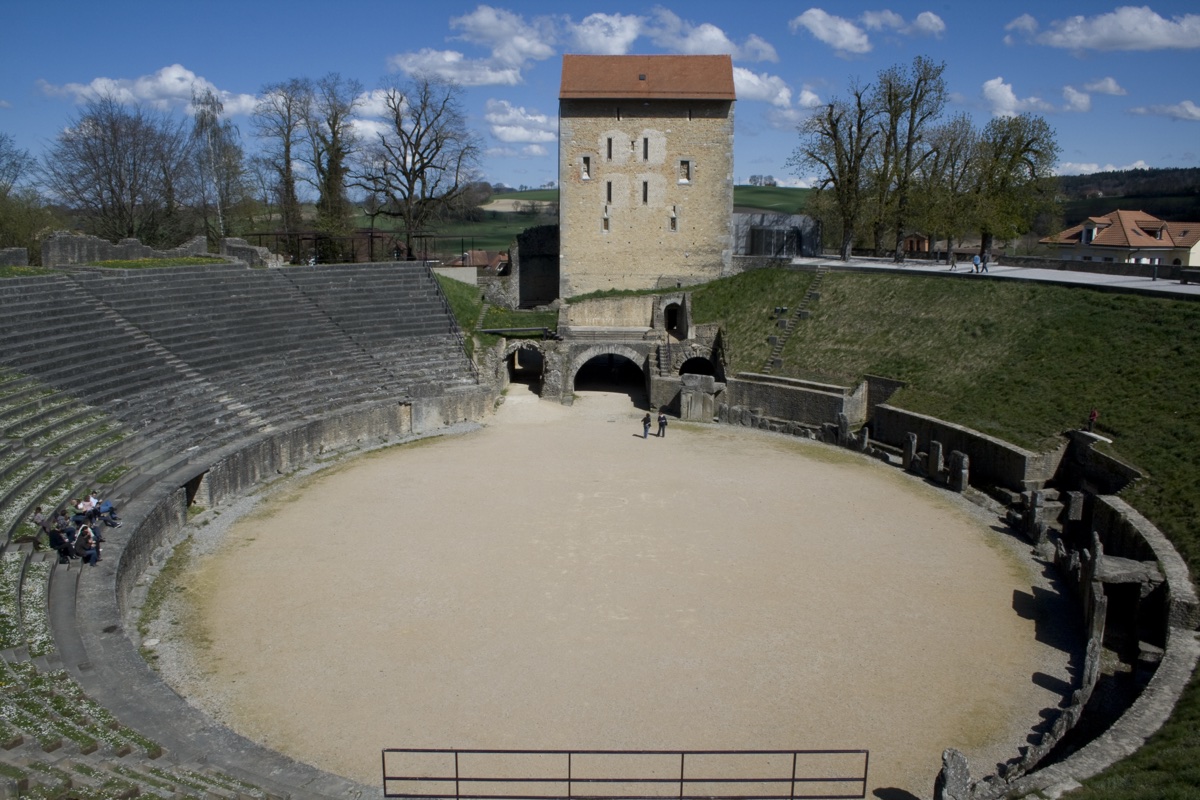
Photo: Ludovic Péron, CC BY-SA 3.0, Wikimedia Commons

In this guide
Why Avenches is Switzerland's forgotten Roman capital
Most visitors to Switzerland associate Roman ruins with Italy or southern France, not a market town between Lausanne and Bern. Yet Avenches — ancient Aventicum — was the capital of the Helvetii people and, under Roman rule, of the entire province of Helvetia. At its height it covered more ground inside its walls than the historic centre of modern Avenches does today, and its population of roughly 20,000 has never been matched again in the town's history.[2]
What makes Avenches worth the trip rather than a footnote is how much of that city survives above ground. The amphitheatre, the theatre, the forum baths and the Tornallaz — the last standing tower of the original 73 — are all visible and freely walkable, and most of the rest of Aventicum lies, still largely unexcavated, under the fields and gardens around the modern town.[3]
Getting there from Montreux
By train (recommended). There is no single direct line, so the practical route runs Montreux – Lausanne – Avenches, changing at Lausanne for a regional train towards Payerne or Fribourg; total journey time is roughly 1 h 50 to 2 h depending on the connection. The amphitheatre is a five-minute walk from Avenches station.
By car. Via Lausanne and Moudon on the A1 and A12, Avenches is about 1 h 15 from Montreux. There is parking near the old town and within walking distance of the Roman site.
Timing. Avenches works well as a late-morning arrival: see the amphitheatre and museum before lunch, eat in the old town, then walk or cycle on to Lake Murten in the afternoon before the train back.
What to see: amphitheatre, museum and the Tornallaz tower
The amphitheatre is the reason to come. Built in the early 2nd century AD with stone stairs, walls and axial entrances and timber seating tiers, it was enlarged after 165 AD into the monumental building visible today — external dimensions of 105 by 92 metres and seating for close to 16,000 across 36 rows.[1] It fell out of Roman use by the 4th century and was quarried for stone for centuries afterwards, which is part of why so little of the original decoration survives — but the arena, the entrance passages and the seating tiers are unmistakably there.[3]
| Site | What it is | Why it matters |
|---|---|---|
| Roman amphitheatre | Arena for gladiator games and animal hunts, enlarged c. 165 AD | Seated ~16,000 across 36 rows; still used for concerts and festivals |
| Roman Museum | Opened 1838, inside a 12th-century tower on the arena's east entrance | Houses the gold bust of Emperor Marcus Aurelius, found in 1939 |
| Roman theatre | Partially excavated performance venue | Shows the civic, not just military, side of Aventicum |
| Tornallaz tower | The sole survivor of the city's 73 Roman towers | The clearest single trace of the 5.5 km Roman wall |
The Roman Museum, opened in 1838 inside the 12th-century fortified tower the bishop of Lausanne built over the amphitheatre's eastern entrance,[2] is compact but holds Aventicum's single best object: a gold bust of Emperor Marcus Aurelius, discovered in 1939 inside a water pipe near the Cigognier sanctuary.[2] It is one of only a handful of gold imperial portraits to survive anywhere in the former Roman Empire.
Opening times and tickets
The amphitheatre itself is an open-air monument you can walk into freely during the day — there is no gate or ticket to see the arena and seating. The Roman Museum, inside the tower, charges a separate entry fee and has seasonal opening hours; check aventicum.org for current times and prices before you travel, since museum and site hours shift between the summer and winter season. [unverified: exact current CHF ticket price — confirm on the official site before travel]
Rock Oz'Arènes and the summer festivals
The amphitheatre's acoustics and setting have made it a working concert venue again, nearly two thousand years after the last gladiator fight. Every August, Rock Oz'Arènes brings an eclectic lineup of international acts to the arena, and most years an international military-music festival follows in September.[3] If you are planning a summer visit around a concert, book tickets and accommodation well ahead — the town is small and fills up fast on festival nights.
When to go, Lake Murten and practical tips
Spring and autumn are the best months for an unhurried, uncrowded visit to the ruins — the amphitheatre is especially atmospheric in low, late-afternoon light. Summer brings the festivals but also the crowds and heat on an arena with little shade. Winter is quiet and free, though museum hours are shorter.
Combine with Lake Murten. Avenches sits a few minutes from Lake Murten (Lac de Morat) and the walled medieval town of Murten/Morat on its far shore — many day-trippers pair the Roman ruins with a lakeside walk, a bike ride around the lake, or a short boat trip, all reachable from Avenches by local bus or a flat, easy cycle.
- Wear flat shoes. The amphitheatre's stone steps and sloped passages are uneven in places.
- Bring water in summer. There is little shade inside the arena.
- Check the museum's hours first, since they vary by season — the amphitheatre itself is always open to walk around.
- Pair it with Murten, an easy add-on by bike or bus if you have a full day rather than a half day.
Base yourself on Lake Geneva
RivieraHost manages apartments in Montreux and Clarens, a short walk from the station. Sleep on the Riviera, take the train north to Switzerland's Roman capital, and be back on the lakefront for dinner.
Check availabilityRelated reading: Gruyères & Maison Cailler: the cheese-and-chocolate day trip · Fribourg: medieval old town day trip from Montreux · Murten: the walled lakeside town day trip · The Swiss Travel Pass and Half-Fare Card explained

10+ years in hospitality. BBA Hospitality (Glion), MSc Tourism (FHGR), MSc Data Science (HSLU).
Frequently asked questions
How do I get from Montreux to Avenches?
Take the train from Montreux to Lausanne, then change for Payerne or Fribourg and get off at Avenches; the whole journey takes roughly 1 h 50 to 2 h depending on the connection. By car it is about 1 h 15 via Lausanne and Moudon on the A1/A12.
What was Avenches in Roman times?
Avenches was Aventicum, the capital of the Helvetii people and of Roman Helvetia, with a population of around 20,000 at its peak — a figure the town has never matched again. It was surrounded by a 5.5 km wall with four gates and 73 towers.
How big is the Avenches amphitheatre?
Built in the early 2nd century AD and enlarged after 165 AD, the amphitheatre reached external dimensions of 105 by 92 metres and held close to 16,000 spectators across 36 rows of seating.
Can I visit the Roman Museum in Avenches?
Yes. The Roman Museum, opened in 1838, occupies a 12th-century fortified tower built over the amphitheatre's east entrance. Its highlight is a gold bust of Emperor Marcus Aurelius, discovered in 1939 in a water pipe near the Cigognier sanctuary.
Is Avenches worth combining with Lake Murten?
Yes. Avenches sits a few minutes from Lake Murten (Lac de Morat) and the walled medieval town of Murten/Morat, so many day-trippers pair the Roman ruins with a lakeside walk or a short boat trip on the same outing.
Sources
- Aventicum — Site et Musée romains d'Avenches, official page on the amphitheatre — construction phases, 165 AD enlargement, external dimensions 105×92 m, capacity ~16,000 across 36 rows — aventicum.org
- Avenches Tourisme / Musée romain d'Avenches, official page — population of Aventicum ~20,000, 5.5 km wall with 4 gates and 73 towers, museum opened 1838 in a 12th-century tower, gold bust of Marcus Aurelius found 1939 — avenches.ch
- Avenches Tourisme, official landmark page on the Roman amphitheatre — early 2nd-century construction, stone-and-timber structure, 4th-century disuse and quarrying, Tornallaz as the sole surviving tower of 73, Rock Oz'Arènes summer festival — avenches.ch
Base yourself in Montreux
RivieraHost’s apartments sit steps from the lake — with kitchens, more space and better value than a hotel for families and groups. Every one is right on this guide’s doorstep.