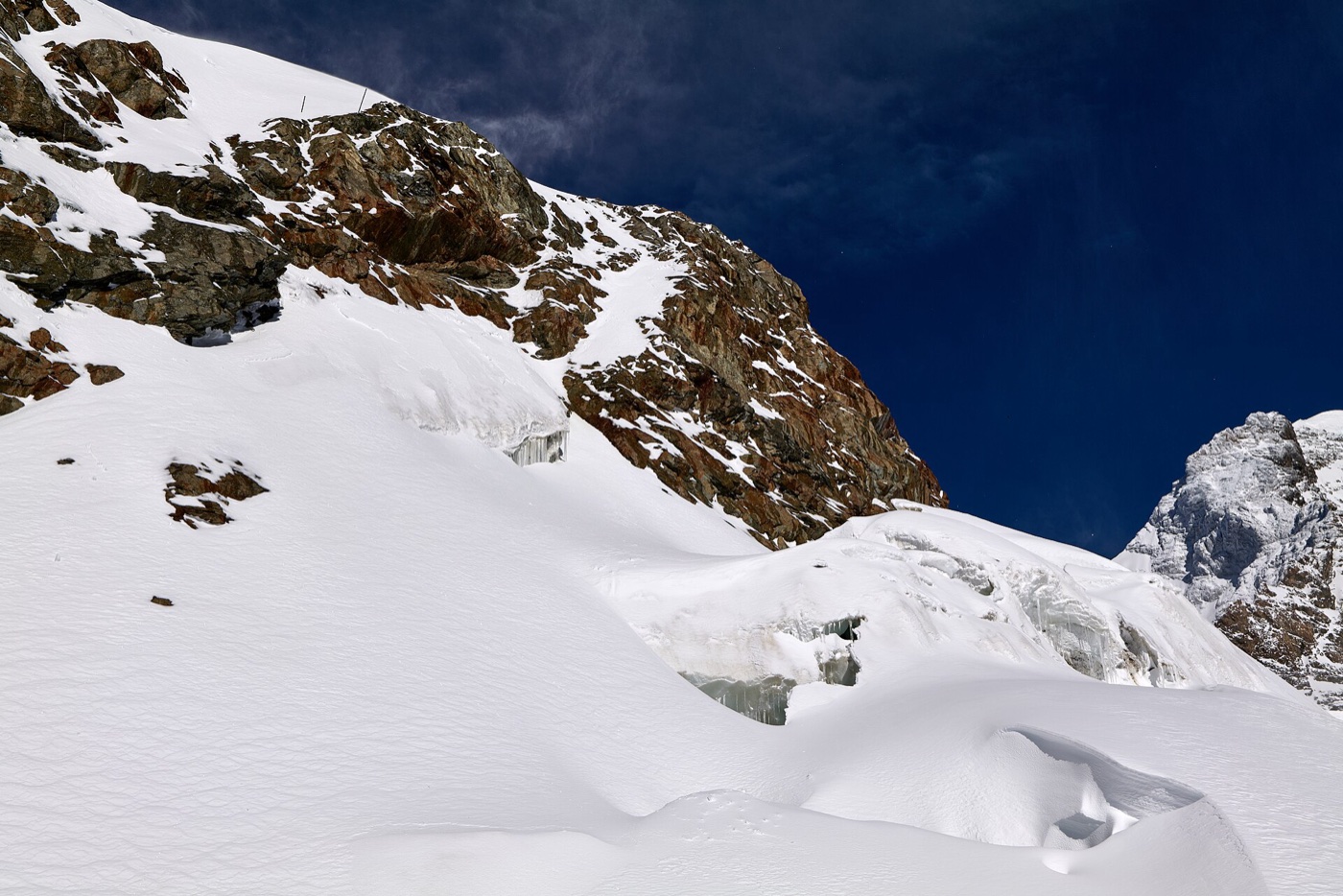
Photo: Leonhard Lenz / Wikimedia Commons, CC0
On this page
Why the Jungfraujoch is worth the journey
There is no single reason to ride up to the Jungfraujoch, which is exactly why it works. The station sits at 3,454 m on the saddle between the Jungfrau and the Mönch, on the rim of the Great Aletsch Glacier, a 23 km river of ice that is visible from the terrace. The Jungfrau Railway has climbed to it through the rock of the Eiger since 1912, and the final 7 km of the line run inside the mountain, which is how a train can deliver you to a glacier without a single step of climbing. Even on a grey day, the altitude and the silence are unlike anything else reachable by rail in Switzerland.[6]
What the ticket actually buys is the Sphinx terrace at 3,571 m, reached by lift from the station, and the Ice Palace, a set of galleries and halls carved into the glacier in the 1930s. A chocolate shop, two restaurants and Europe's highest post office sit inside the building, and a snow play area just outside lets you stand on permanent snow a few metres from the door. No hiking gear is required, but 3,400 m is real altitude: go up slowly, drink water, and give yourself twenty minutes to adjust if you are travelling with children or older relatives.
Clear weather is what turns this from a very expensive train ride into one you will remember, so check the summit webcam before you commit and buy your ticket on the day if you can. From the terrace the Aletsch Glacier runs away towards the Rhône valley, with the Eiger, Mönch and Jungfrau lined up side by side. Snow, ice and a genuine below-zero wind in the middle of August are the other half of the experience: 3,400 m above Lake Geneva is a different climate, not a different view.
If you are building a week of day trips from Montreux, theGruyères and Maison Cailler day trip covers the other half of the story — the medieval cheese town and the oldest chocolate factory open to the public in Switzerland, both far closer to Montreux.
Getting there from Montreux
The route is straightforward but not short. The 08:10 departure from Montreux reaches the Jungfraujoch at 12:11, a run of 4h01 with five changes, usually in Lausanne or Visp, Spiez, Interlaken Ost, Grindelwald Terminal and on the Eiger Express. If you would rather start with a direct train, the 07:32 GoldenPass runs from Montreux to Interlaken Ost in 3h16 without a change, and from Interlaken the mountain railway takes about another 1h37 with a change at Grindelwald Terminal or Kleine Scheidegg.[1]
From Interlaken Ost the Bernese Oberland Railway climbs to Grindelwald Terminal, where the Eiger Express, a tricable gondola, lifts you to the Eigergletscher in 18 minutes. From there the Jungfrau Railway takes over and bores through the Eiger for the final stretch, pausing twice at viewing windows cut into the rock face. The whole chain is seamless: one ticket, coordinated timetables, and no car park to hunt for at 2,000 m.[5]
One detail that catches people out: this is not one price from end to end. Regional passes cover the route as far as Grindelwald or the Eigergletscher, but the final climb from the Eigergletscher to the Jungfraujoch is bought separately, at a fixed supplement, and the Jungfrau Travel Pass is the one that includes the summit. Check what your pass already covers before you buy the mountain ticket.[5]By car the drive is about 200 km of motorway to Grindelwald, plus a compulsory parking charge at the Terminal, and you would still be buying the same mountain ticket at the top. For a day trip from Montreux the train is not simply greener, it is faster and cheaper.
Inside Europe's highest railway station
Inside, the Jungfraujoch is three things stacked on top of each other: a railway station, an observation deck and a small high-altitude village with restaurants, shops and a post office. Everything is indoors or a few dozen metres outside, linked by lifts and tunnels cut through the rock, so you can spend three hours up there in ordinary clothes provided you have a warm layer and shoes with grip.[2]
Citation capsule.The Jungfraujoch station sits at 3,454 m and is the highest railway station in Europe; the Sphinx terrace above it reaches 3,571 m. The Jungfrau Railway has served it since 1912, and the Great Aletsch Glacier — 23 km long, the largest glacier in the Alps — starts directly below the terrace.Source: www.jungfrau.ch — Jungfraujoch, Top of Europe
The Ice Palace is the part most visitors remember: galleries and chambers carved into the glacier itself, with ice sculptures lit from below and a temperature that stays below freezing all year, so gloves are a good idea even in July. Beside it, the chocolate shop and the self-service restaurants cover the practical side of three hours at altitude, and a small cinema runs the story of the railway's construction inside the mountain. Between the two, the time goes faster than most people expect.[4][6]
Beyond looking at the view, the Jungfraujoch has a short list of fixed experiences: the Alpine Sensation walk-through on the way to the Ice Palace, the Snow Fun area on the glacier side for sledging and snow play in summer, and a plate of rösti at 3,454 m, which tastes better than it has any right to. Photography is the other activity, and the light matters: midday in summer is harsh, so the best shots of the Aletsch Glacier come on the early trains or in the late afternoon.[4]
Two things are worth knowing before you buy. First, the Jungfraujoch ticket is a return and the mountain section is not covered in full by a Swiss Travel Pass, which gives a discount rather than free travel, so check what your pass includes. Second, food up there is expensive and unremarkable, and a sandwich bought in Interlaken or Grindelwald costs a third of the same lunch at 3,454 m.
When to go, what it costs and a realistic day
The Jungfraujoch runs every day of the year, and every season has its own case. Late June to early September is warmest and busiest, with long days and the best odds of a terrace you can enjoy in a T-shirt. September and the first half of October usually give the sharpest views with fewer people, and winter is cold but quiet, with the light on the glacier at its most spectacular. If you are here for the scenery rather than the snow, plan the day around the webcam and travel when the summit is above the cloud, not when the calendar says summer.[3]
| Ticket | Price (2026) | Notes |
|---|---|---|
| Return from Grindelwald Terminal | from CHF 129.60 | Eiger Express + Jungfrau Railway, about 45 min |
| Good Morning Ticket | −15% | Early departures, 1 May – 31 Oct 2026 |
| Seat reservation | CHF 10 | Strongly advised whenever the summit is clear |
| Jungfrau Travel Pass (3–8 days) | from CHF 165 | Region-wide travel, boats included |
| Unlimited Summer Pass | CHF 449 | 3 Apr – 29 Nov 2026, Jungfraujoch included |
| Unlimited Winter Pass | CHF 399 | 1 Dec 2026 – 30 Apr 2027, Jungfraujoch included |
The ticket covers the Sphinx terrace, the Ice Palace and the cinema, so the only extras above 3,400 m are food and the chocolate shop. Official 2026 fares, family reductions and seasonal variations are on the operator's own tariff page[4]Seat reservation is the one addition worth paying for. The Jungfrau Railway climbs through a single-track tunnel, so departures are strictly limited, and in fine weather the late-morning trains sell out days ahead in July and August. Reserving costs CHF 10 and turns a hopeful arrival at Grindelwald Terminal into a departure you can build the day around.
A realistic day from Montreux, built around the timetable rather than hope:
- 08:10 Montreux — departure on the fastest connection of the day, arriving at the Jungfraujoch at 12:11.
- 12:11 Jungfraujoch — straight up to the Sphinx terrace while the summit is still above the cloud, then the Ice Palace, lunch and the snow.
- 15:15 Jungfraujoch — the last comfortable descent for a same-day return, arriving back in Montreux at 19:22.
- 16:45 Interlaken Ost — an hour for dinner in Interlaken, or stay on the train with a sandwich and keep moving.
- 19:22 Montreux — back on the lake after 4h07 on the return leg, roughly eleven hours after locking the door.
It is a full day, not a half day, and the 200 km of railway is unavoidable whichever way you go up. If you would rather reach high alpine ground with far less travelling, the Titlis and Engelberg guide is the same kind of excursion with a glacier at the end of it, and considerably less travelling.
Kleine Scheidegg, Grindelwald and the Bernese Oberland
Kleine Scheidegg, at 2,061 m, is the hinge of the whole system: the trains from Grindelwald and from Lauterbrunnen meet there, and the Jungfrau Railway starts its climb into the mountain. If you have time on the way down, break the journey at the Eigergletscher station at 2,320 m, where the Eiger Express arrives, and walk the twenty minutes down to Kleine Scheidegg with the north face of the Eiger on your left. It is the best free addition to an expensive day.
Grindelwald Terminal, at the bottom of the Eiger Express, is a resort in its own right, with the First gondola and a summer luge track, and it is the natural place to spend a night if you want to split the trip in two. Interlaken Ost, an hour and a half below, is where the two mountain lines meet again, and one stop further on, Lauterbrunnen is the valley of the waterfalls and the gateway to Wengen, Mürren and the Schilthorn.
If you prefer your wine and lake terraces to your altitude, theLavaux vineyard terraces are on the doorstep of Montreux rather than 200 km away, and a train down the lakeshore plus a walk through the terraces makes a perfect recovery day between two mountain trips. Most guests put one big excursion at each end of the week and fill the middle with Chillon, Lavaux and the lake.
Base yourself on Lake Geneva
The practical difference between a good Jungfraujoch day and a miserable one is how close you are to the platform at 08:00. RivieraHost's serviced apartments in Montreux and Clarens sit a short walk or a five-minute bus ride from Montreux station, which makes an 08:10 departure, a packed lunch and a 19:22 return easy to do without a car.
See our apartmentsFrequently asked questions
Can you do the Jungfraujoch as a day trip from Montreux?
Yes. The fastest connections take 4h01 each way: the 08:10 train from Montreux arrives at the Jungfraujoch at 12:11, and the 15:15 return brings you back to Montreux at 19:22. That leaves around three hours on the summit, which is enough for the Sphinx terrace, the Ice Palace, lunch and the snow.[1]
How much does the Jungfraujoch cost in 2026?
From CHF 129.60 for a return from Grindelwald Terminal. The Good Morning Ticket takes 15% off early departures between 1 May and 31 October 2026, a seat reservation is CHF 10, and passes start at CHF 165. From Montreux the rail fare to Grindelwald Terminal is extra unless your Swiss Travel Pass covers it.[4]
Do I need to reserve a seat on the mountain train?
It is not compulsory, but the Jungfrau Railway runs through a single-track tunnel with a fixed number of departures, and in good weather the late-morning trains sell out days ahead in high season. CHF 10 secures a named departure in both directions, which is cheap insurance on a day this long.[3][4]
Is the Jungfraujoch worth it if the weather is bad?
Partly. The station, the Ice Palace and the views from inside the building work in any weather, and the snow is guaranteed, but the terrace and the glacier panorama are what you are really paying for. Check the live webcam in the morning; if the summit is in cloud, move the trip to another day and take the GoldenPass to Interlaken instead.
Can you see the Aletsch Glacier from the terrace?
Yes, when the weather cooperates: the Sphinx terrace looks straight onto the Great Aletsch Glacier, 23 km of ice running towards the Rhône valley, and it is the largest glacier in the Alps. On a clear day it is visible for most of the year, and it is the single best reason to buy the ticket.[3]
Sources
- SBB / opendata.ch public timetable — Montreux–Jungfraujoch connections (08:10–12:11 out, 15:15–19:22 back) and the 07:32 GoldenPass to Interlaken Ost.
- Jungfrau Railways (jungfrau.ch) — Jungfraujoch, Top of Europe: station at 3,454 m, the highest railway station in Europe; Sphinx terrace 3,571 m; Ice Palace; snow and ice 365 days a year.
- Jungfrau Railways — tickets and prices: return from CHF 129.60, Good Morning Ticket −15% (01.05–31.10.2026), seat reservation CHF 10, Jungfrau Travel Pass from CHF 165, Summer Pass CHF 449, Winter Pass CHF 399.
- Jungfrau Railways — Eiger Express and journey times: tricable gondola Grindelwald Terminal–Eigergletscher in 18 minutes; Interlaken Ost to Jungfraujoch in about 1h30.
- Jungfrau Railways — Jungfrau Railway history and operation: opened in 1912; Kleine Scheidegg 2,061 m and Eigergletscher 2,320 m as the railway's two intermediate stations.
- Wikipedia — Jungfraujoch (station at 3,454 m, the Sphinx Observatory, Europe's highest post office) and Aletsch Glacier (23 km long).
- Hero photograph: Leonhard Lenz, ‘Sphinx at Jungfraujoch’, CC0, via Wikimedia Commons —file page.

10+ years in hospitality. BBA Hospitality (Glion), MSc Tourism (FHGR), MSc Data Science (HSLU).
Base yourself in Montreux
RivieraHost’s apartments sit steps from the lake — with kitchens, more space and better value than a hotel for families and groups. Every one is right on this guide’s doorstep.