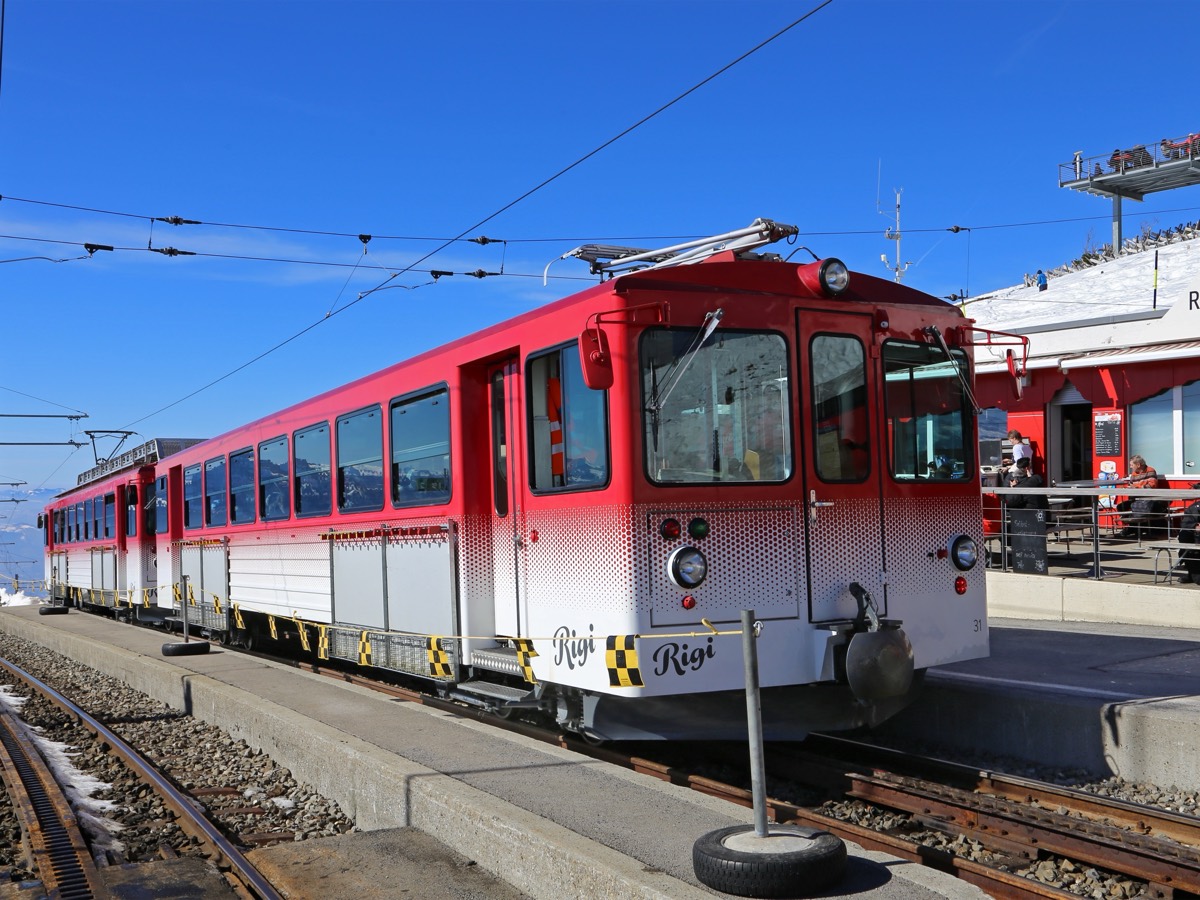
Photo: W. Bulach / Wikimedia Commons, CC BY-SA 4.0
On this page
Why the Rigi is worth the journey
The Rigi is the mountain that made Swiss mountain tourism. It rises out of the lake country north-east of Lucerne, ringed by Lake Lucerne, Lake Zug and Lake Lauerz, and its summit — Rigi Kulm, 1,797 m — was the first Alpine viewpoint that ordinary travellers could reach without walking up.[5] The nickname came with the crowds: the Queen of the Mountains.
What makes it a good day out from Lake Geneva is not a single engineering stunt, but the combination. On one mountain you get a historic cogwheel railway, a car-free mid-mountain village, a mineral spa designed by Mario Botta, and a summit panorama that reaches 24 of Switzerland's 26 cantons — all but Geneva and Basel.[3] Nine mountain railways operate on the Rigi: two cogwheel lines and seven cable cars.[3]
In summer there are 120 km of marked hiking trails, and the mountain is one of the richest orchid areas in central Switzerland, with 37 of the roughly 60 Swiss species recorded on its slopes.[3] If you are weighing up mountains, the Rigi is the gentler half of the Lucerne pair: for the record-breaking side of the same lake, see our Titlis and Engelberg guide.
Getting there from Montreux
By train, the connection does not change all day: 07:08 from Montreux, 11:34 at Rigi Kulm, 4h26 with three changes (Lausanne, Olten or Zürich, then Arth-Goldau for the south-side cogwheel). That is the version for travellers who want the summit first and the descent as late as possible.[1]
The second version is the one we would choose. Take the same 07:08, but leave the train in Lucerne and walk to the pier beside the station: the 10:12 boat reaches Vitznau at 11:09, which puts you at the foot of the 1871 cogwheel railway with the lake behind you and the summit directly above.[1] The boat leg is the reason many people rate this route above the Pilatus round trip; Swiss Travel Pass holders travel on it free.
By car, the mountain is a deliberate detour: Montreux to Vitznau is about 230 km and 2h45 of motorway, and Montreux to Arth-Goldau about 226 km and 2h35.[6] Both are park-and-ride villages — there is no road up the Rigi itself — so you trade the train for a car park either way.
For the return, the day works if you leave the summit on the 15:48, which puts you back in Montreux at 20:51; a later departure at 17:48 arrives at 22:51 and leaves no margin.[1] If you would rather spend the day on the water instead of climbing, the Rhine Falls is the flatter alternative.
Three ways up the mountain
From Vitznau — the Vitznau-Rigi railway, opened on 21 May 1871, holds the title of Europe's first mountain railway. It is standard gauge with a Riggenbach rack, and the first train reached the summit itself on 23 June 1873; in 1874, its fourth year, it carried more than 100,000 passengers — a worldwide sensation at the time.[2] This is the line to take if you arrive by boat.
From Arth-Goldau — the Arth-Rigi railway opened on 4 June 1875 and climbs from the Schwyz side. Its Goldau–Rigi Kulm section was electrified on 1 May 1907, which made it the first electrified standard-gauge cogwheel railway in the world.[2] It is the fastest approach by car and the one the 07:08 connection uses.
From Weggis — the aerial cable car from Weggis up to Rigi Kaltbad has been in operation since 15 July 1968 and takes about ten minutes, which makes it the shortcut if your only goal is the spa.[2]
The record that started it all: the cogwheel railway from Vitznau to Rigi Staffelhöhe was inaugurated on 21 May 1871 as Europe's first mountain railway, on the 54th birthday of its engineer Niklaus Riggenbach. Two years later, on 23 June 1873, trains ran the ‘parade section’ to the summit for the first time, and 1874 brought over 100,000 passengers in a single season. Source: www.rigi.ch
Rigi Kaltbad and the Mineralbad & Spa
Rigi Kaltbad sits halfway up the mountain and is reached only by railway or cable car. Its mineral bath is old: the village has been a bathing place for some 600 years, and the original spring is still the reason people stop here.[7] What is new is the building.
The Mineralbad & Spa Rigi Kaltbad was designed by the Ticinese architect Mario Botta and opened on 1 July 2012, together with the remodelled village square and hotel.[2] Inside there are mineral pools, a steam bath and rest rooms, with a glass façade opening onto an outdoor pool that faces the lake and the Alps. Entry is charged separately from the railway ticket, and the spa is open year-round — check current opening hours on rigi.ch before you travel.
If thermal water is the actual reason for your trip, the Rigi is not the only option on the Swiss side: our thermal baths of Vaud and Valais covers the spas you can reach in an afternoon from Montreux.
Rigi Kulm and the summit panorama
Above Kaltbad the railway climbs to Rigi Kulm, 1,797 m, the highest point of the massif.[5] Walk a few minutes from the station and the whole plateau opens: Lake Lucerne below, the chain of the Alps from Säntis across to the Bernese Oberland, and on a clear day 24 of the 26 cantons.[3] Two are always missing — Geneva and Basel.
The best hours are the early ones. Rigi Kulm is famous for its sea of fog in autumn: the valley can sit under grey cloud while the summit is in full sun. Check the summit webcams before leaving Montreux; they decide the trip far more reliably than a forecast does.
In winter the same railway keeps running — the Vitznau line has operated in winter since 1906 — and the summit plateau turns into sledging and snowshoe country, with the spa at Kaltbad still open below.[2]
When to go, what it costs and a realistic day plan
Unlike the Pilatus cogwheel railway, which closes for the winter, the Rigi runs all year.[2] Late September and October are the sweet spot: clear air, thinning crowds and the first snow on the high peaks. July and August are the busiest months, and every sunny weekend is busy in any season.
| Ticket | Price (2026) | Notes |
|---|---|---|
| Rigi day pass, adult | CHF 84 | All Rigi railways and cable cars for one day |
| Rigi day pass with Half-Fare card | CHF 42 | Swiss Half-Fare Card holders pay half |
| GA travelcard / Swiss Travel Pass | free | The Rigi is fully included; no extra mountain ticket |
| Children up to 15.99, accompanied | free | When accompanied by a paying adult |
| Vitznau–Rigi Kulm | CHF 52 single / CHF 84 return | Single line, price depends on the section |
| Arth-Goldau–Rigi Kulm | CHF 84 return | The south-side approach from Schwyz |
Prices are the published 2026 Rigi Bahnen tariffs; the day pass is the simplest ticket because it covers every line on the mountain.[4]
A realistic day from Montreux, using the timetable rather than guesswork:
- 07:08 — leave Montreux by train; three changes, arriving Lucerne around 10:17.
- 10:12 — boat from the pier beside Lucerne station to Vitznau, arriving 11:09.
- 11:15 — cogwheel railway from Vitznau up to Rigi Kaltbad: the spa, the village and lunch.
- 14:30 — continue by cogwheel to Rigi Kulm for the panorama and a short walk on the plateau.
- 15:48 — descend; back in Montreux at 20:51.
- Need longer on the summit? The 17:48 departure reaches Montreux at 22:51.
It is a long day — roughly eight hours of travelling for four hours on the mountain — but unlike the Jungfraujoch it needs no overnight stay. Staying in Montreux and leaving on the 07:08 is the whole plan.[1]
Base yourself on Lake Geneva
RivieraHost manages apartments and villas in Montreux, Clarens and the surrounding Riviera — a quiet base between the lake and the Alps, with the Montreux Riviera Card included for guests and a station that puts Lucerne, the Bernese Oberland and the Valais within a day's reach.
See our apartmentsAlso read: Titlis: Europe's highest suspension bridge · Zermatt and the Matterhorn as a day trip · Rhine Falls day trip from Montreux
Frequently asked questions
Can you visit Mount Rigi as a day trip from Montreux?
Yes. The 07:08 from Montreux reaches Rigi Kulm at 11:34 with three changes, or you leave the same train in Lucerne and take the 10:12 boat to Vitznau, arriving at 11:09. The return departure at 15:48 gets you back to Montreux at 20:51, which gives you four hours on the mountain.
How much does Mount Rigi cost in 2026?
A Rigi day pass costs CHF 84 for adults and CHF 42 with a Swiss Half-Fare Card. It is free with a GA travelcard or a Swiss Travel Pass, and accompanied children up to 15.99 travel free. Single-line returns, such as Vitznau–Rigi Kulm, also cost CHF 84.
Is Mount Rigi car-free?
Yes — there is no road to Rigi Kaltbad or the summit. Drivers park at Vitznau, Weggis or Arth-Goldau and continue by cogwheel railway or cable car. From Montreux, the train is 4h26 to the summit, so the car only makes sense if you are combining the Rigi with other stops in central Switzerland.
Does the Rigi railway run in winter?
Yes. The summit can be reached all year, and the Vitznau line has run in winter since 1906. Snow turns the plateau into sledging and snowshoe terrain, and the Mineralbad & Spa at Rigi Kaltbad stays open. Only the high-level hiking trails close.
What is the best time of day to go up the Rigi?
Morning, especially between late September and the end of October, when the valley often lies under a sea of fog and the summit above 1,600 m stands in sunshine. Check the summit webcams before you leave Montreux: they are a better guide than the forecast.
Sources
- SBB / opendata.ch public timetable — connections Montreux → Rigi Kulm, Montreux → Vitznau (via Lucerne, boat) and Rigi Kulm → Montreux, query of 23 September 2026 for Saturday 3 October 2026 — transport.opendata.ch/v1/connections
- Rigi Bahnen (rigi.ch) — railway history: inauguration of Europe's first mountain railway on 21 May 1871 (Vitznau to Rigi Staffelhöhe), first run to the summit on 23 June 1873, more than 100,000 passengers in 1874, opening of the Arth-Rigi railway on 4 June 1875, electrification of Goldau–Rigi Kulm on 1 May 1907, winter operation of the Vitznau line since 1906, Weggis–Rigi Kaltbad cable car in operation since 15 July 1968, grand opening of the Mineralbad & Spa on 1 July 2012 — rigi.ch/en/about-us/history/railway-history
- Rigi Bahnen (rigi.ch), facts page — 24 of the 26 cantons visible from Rigi Kulm (all except Geneva and Basel), nine mountain railways on the mountain (two cogwheel, seven cable cars), 120 km of hiking trails in summer, 37 of roughly 60 native orchid species — rigi.ch/en/about-us/company/facts
- Rigi Bahnen (rigi.ch), tickets and offers — Rigi day pass CHF 84 for adults, CHF 42 with Half-Fare, free with GA or Swiss Travel Pass, accompanied children free, Vitznau–Rigi Kulm CHF 52 single and CHF 84 return — rigi.ch/en/tickets-offers
- Rigi (Wikipedia) — Rigi Kulm at 1,797 m, the highest point of the massif, between Lake Lucerne, Lake Zug and Lake Lauerz — en.wikipedia.org/wiki/Rigi
- Route distance and driving time from Montreux to Vitznau and to Arth-Goldau calculated with the OSRM routing engine — project-osrm.org
- Hotel Rigi Kaltbad — 600-year-old bathing tradition of the ‘Chalte Bad’, revived with the Mineralbad & Spa in summer 2012 — hotelrigikaltbad.ch
- Hero photograph: W. Bulach, ‘Rigi-Bahnen — Schweiz’, own work, CC BY-SA 4.0 — Wikimedia Commons

10+ years in hospitality. BBA Hospitality (Glion), MSc Tourism (FHGR), MSc Data Science (HSLU).
Base yourself in Montreux
RivieraHost’s apartments sit steps from the lake — with kitchens, more space and better value than a hotel for families and groups. Every one is right on this guide’s doorstep.