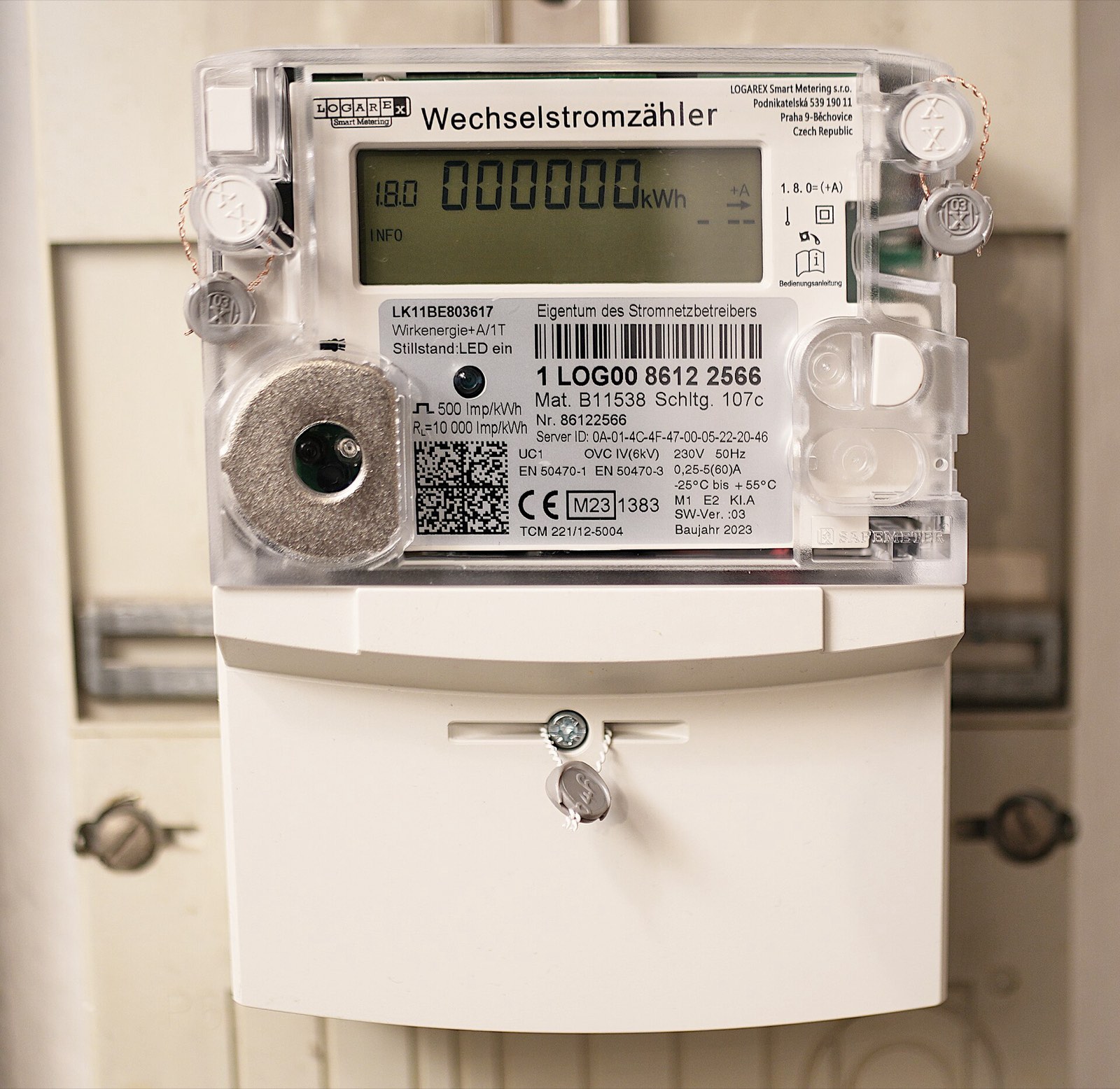
Photo: RobbieIanMorrison, CC BY 4.0, via Wikimedia Commons

The nightly rate is the easy part. What decides whether a Montreux short-let earns what the spreadsheet promised is the small stack of invoices nobody models: the electricity bill that arrives in January, the media fee, the building's ancillary charges, the linen, the platform's cut. Individually none of them is frightening. Together they are the difference between a flat that earns and a flat that only looks like it does. Here is that stack for 2027, priced from the official figures rather than from a rule of thumb — including the one line that moved in your favour.
The short answer. At the median Swiss tariff for 2027 — 26.5 ct./kWh, 1.2 ct./kWh below 2026[1] — a two-guest flat modelled at 2 190 kWh a year carries about CHF 580 of electricity and a four-guest flat modelled at 3 065 kWh about CHF 812.[2] The household media fee falls to CHF 312 on 1 January 2027 from CHF 335.[4] Those two lines together come to roughly CHF 1’124 a year for a four-guest flat — about CHF 94 a month. Everything else — common-area electricity, building services, water — is billed through the ancillary charges rather than through your own meter.[3]
Electricity in 2027: the median tariff falls to 26.5 ct./kWh
On 8 September 2026 the federal Electricity Commission (ElCom) published the tariffs that Switzerland's roughly 580 distribution-network operators will apply in 2027. For a household on the standard consumption profile H4 — 4 500 kWh a year, the reference ElCom uses for the median household — the all-in tariff falls to 26.5 ct./kWh, 1.2 ct./kWh below 2026, which is a bill of CHF 1’194 a year, CHF 53 less than this year.[1]
For an owner the composition matters more than the headline, because the components move in opposite directions:
| Tariff component | 2027 | 2026 |
|---|---|---|
| Energy tariff[1] | 11.35 ct./kWh | 12.11 ct./kWh |
| Network usage tariff[1] | 10.94 ct./kWh | 10.73 ct./kWh |
| Measurement, household (H4)[1] | CHF 78.48 / year | CHF 74.40 / year |
| Network supplement[1] | 2.30 ct./kWh | 2.30 ct./kWh |
| Electricity reserve[1] | 0.17 ct./kWh | 0.41 ct./kWh |
| Solidarity-cost supplement[1] | 0.19 ct./kWh | 0.05 ct./kWh |
| Levies to public bodies[1] | 1.00 ct./kWh | 1.00 ct./kWh |
Median values published by ElCom on 8 September 2026 for the H4 household profile; 2026 figures shown for comparison.[1]
Read as an owner, the message is precise: the energy you consume becomes cheaper, while the fixed and network side — measurement in particular, up about CHF 4 a year — becomes more expensive. A flat with low consumption therefore captures less of the 2027 reduction than a flat with heavy consumption. The medians also hide a wide spread: ElCom notes that prices vary considerably between network operators, mainly because of how each one procures its energy.[1] Montreux has its own network operator, so the number that matters is the one on your own invoice — ElCom publishes every commune's tariffs so you can compare.[1]
What the official figure actually says. “Un ménage type paiera l’année prochaine 26,5 centimes par kilowattheure (ct./kWh)” — a reference household will pay 26.5 centimes per kilowatt-hour next year, a fall of 1.2 ct./kWh that ElCom attributes mainly to lower energy-procurement costs.[1] Note the phrase ménage type: it describes a modelled household without electric heating or electric hot water. A holiday flat with a washer-dryer, a dishwasher and a heated towel rail is not that household.
Why a four-guest flat burns more than the model suggests
The model behind those figures separates apartments from houses and counts occupants. A two-person apartment comes in at 2 190 kWh a year and a four-person apartment at 3 065 kWh, against 2 860 and 4 050 kWh for the same households in a detached house.[2] The 5 000 kWh per household that gets quoted so often is higher for a reason the federal documentation states plainly: it is pulled upwards by energy-intensive buildings, which is why the modelled household is the better comparator.[3]
The model also says where the load sits. Almost half of a modelled household's electricity goes on cooking, dishwashing, washing and drying,[2][3] and laundry alone accounts for 16% of the total.[3] For a rental that is the whole story. Guests do not live in the flat, they stay in it: linen and towels turn over at every changeover, the dishwasher runs after every meal, and the dryer runs hardest in the season when the flat is full.
Do the arithmetic at the 2027 median tariff. The 875 kWh that separate a four-person apartment from a two-person one correspond to about CHF 232 a year — the price of a second bedroom being occupied rather than a change in anyone's behaviour. Laundry's 16% share of a four-person flat is roughly 490 kWh, about CHF 130.[1][2][3] And the full four-person consumption of 3 065 kWh works out at about CHF 2.23 a day — an amount that disappears inside a single night's rate, which is exactly why electricity belongs in your model rather than in your panic.
Five running costs that never appear on the electricity invoice
| Line | 2027 figure | Who pays |
|---|---|---|
| Household media fee (Serafe)[4] | CHF 312 a year from 1 Jan 2027 (CHF 335 in 2026) | Owner — one fee per dwelling, whatever the number of bookings |
| Common-area electricity: lift, corridors, exterior lighting, building services[3] | Inside the ancillary charges | Owner — not on the individual meter, no matter how the flat is let |
| Water and hot water | Ancillary charges, or metered | Owner — consumption tracks occupancy, not floor area |
| Internet, television, connected extras | Per listing, per year | Owner — guests expect it, few models include it |
| Linen, towels and consumables | Per changeover | Owner — the one line that grows with occupancy rather than with the flat |
The first two rows are the sourced points: the media fee, and the fact that a flat's common-area electricity is billed through the ancillary costs rather than on the individual annual invoice.[3][4] The last three rows are structural lines of the same stack, described rather than priced — your own invoices set them.
Two further lines get mistaken for running costs and are not the same thing at all. The platform's commission is deducted from the payout before you ever see it — our guide to the platform fee on a Montreux listing walks through what that costs across a season. And the tourist tax is not your cost: it is collected per guest and per night and remitted, which is why it has to be configured correctly on every booking rather than absorbed into the rate — the mechanics are in our tax and VAT guide.
What it adds up to for a Montreux flat
| Direct running cost, 2027 | Two-guest flat | Four-guest flat |
|---|---|---|
| Electricity at 26.5 ct./kWh[1][2] | 2 190 kWh — CHF 580 | 3 065 kWh — CHF 812 |
| Serafe household fee[4] | CHF 312 | CHF 312 |
| Total, the two lines you own outright | CHF 892 a year ≈ CHF 74 a month | CHF 1’124 a year ≈ CHF 94 a month |
Spread over a season, a four-guest flat's electricity and media fee amount to CHF 5.62 a night if the flat lets 200 nights. That is the honest scale of the direct utility line: small next to the rate, and easy to lose control of when nobody is watching consumption, meter readings or the ancillary statement. The building's own charges sit outside this table because the owners' association sets them, not your guests' behaviour — which is precisely the document to read before you list the flat.
What a manager changes — and what it does not
No manager renegotiates the electricity tariff for you: it is set by the network operator and monitored by the regulator. What professional operation changes are the two variables that dominate the running-cost line — how many nights the flat actually earns, and what each of those nights consumes. Our own Montreux apartments run at around 87% occupancy, roughly 34% above what the same flats produced self-managed, and we take licensed apartments only. The fee is a flat 20% of the host payout (after platform fees, cleaning and city tax included), with no setup fee; the contract runs for one year, then 30 days’ notice. The invoices above stay yours — the difference is the number of nights standing behind them.
Put a real number on the flat
Send us the address and the number of bedrooms. You get a free, itemised estimate — occupancy, nightly rate and projected annual revenue for the Montreux–Riviera market — and you keep your own bills. Flat 20% commission of the host payout (after platform fees, cleaning and city tax included), no setup fee.
Get a free revenue estimateThe running costs are the floor, the furnishing bill is the entry ticket, and the rate is what sits on top of both. If the flat is inside a condominium, the ancillary statement is the first document to read, and if you are still weighing management against self-management, the hidden costs of self-managing a Montreux rental prices the hours that would otherwise be yours. The rest of the owner material — revenue, pricing, compliance and market data — sits in the owner guides hub.

10+ years in hospitality. BBA Hospitality (Glion), MSc Tourism (FHGR), MSc Data Science (HSLU).
Frequently asked questions
How much does electricity cost for a short-term rental in Montreux?
At the median 2027 tariff of 26.5 ct./kWh,[1] a two-guest flat modelled at 2 190 kWh a year costs about CHF 580 and a four-guest flat at 3 065 kWh about CHF 812.[2] That covers the flat's own consumption only: the electricity of the building's common areas is not shown on the individual annual invoice but is billed within the ancillary costs.[3]
Did Swiss electricity prices go up or down for 2027?
Down, at the median. ElCom's figures give a household on the H4 profile an all-in tariff of 26.5 ct./kWh, 1.2 ct./kWh less than 2026, equal to CHF 1’194 a year, or CHF 53 less.[1] Inside that total the energy tariff falls from 12.11 to 11.35 ct./kWh while the network tariff rises from 10.73 to 10.94 ct./kWh and the measurement charge rises by about CHF 4 a year.[1] Heavy-consumption flats gain more; low-consumption flats gain less.
Do I pay the Serafe media fee on a holiday flat?
Yes — it is a household fee, one per dwelling, regardless of how many bookings the flat takes. It currently stands at CHF 335 a year for private households and will be reduced to CHF 312 from 1 January 2027 on the Federal Council's decision.[4] On a flat let 200 nights a year that is CHF 1.56 a night.
Is 5 000 kWh a year the right figure to budget for?
It is the average, and the federal documentation is explicit that it is inflated by energy-intensive buildings.[3] The modelled household — 2 190 kWh for a two-person apartment, 3 065 kWh for a four-person one[2] — is the better comparator, and a short-let runs above the model because roughly half of a household's electricity goes on cooking, dishwashing, washing and drying, with laundry alone at 16%.[2][3]
Sources
- Commission fédérale de l’électricité (ElCom), « Légère baisse des prix de l’électricité en 2027 », press release of 8 September 2026 — median all-in tariff of 26.5 ct./kWh for the H4 household profile (4 500 kWh), 1.2 ct./kWh below 2026, i.e. CHF 1’194 a year (−CHF 53); breakdown by tariff component; tariffs per commune published for comparison. Consulted 18 October 2026.
- SuisseEnergie / Office fédéral de l’énergie, Appareils électriques à haute efficacité énergétique — modelled household consumption of 2 860 kWh (two-person house) and 2 190 kWh (two-person apartment), 4 050 kWh (four-person house) and 3 065 kWh (four-person apartment); nearly half of a household's electricity goes to cooking, dishwashing, washing and drying. Consulted 18 October 2026.
- Office fédéral de l’énergie (OFEN), fiche d’information « Comment définit-on le ménage-type ? », August 2021 — the average household consumption of 5 000 kWh a year is distorted upwards by energy-intensive buildings; for an apartment, the cost of the common-area electricity does not appear on the individual annual invoice but in the ancillary costs; consumption split by use (16% laundry and drying of linen).
- Serafe AG, redevance radio et télévision — CHF 335 a year for private households, to be reduced to CHF 312 from 1 January 2027 on the Federal Council's order. Consulted 18 October 2026.
Tariffs and fees consulted 18 October 2026. General information on running costs, not tariff or tax advice — your commune's published tariff and your building's ancillary statement govern your own figures.
Base yourself in Montreux
RivieraHost’s apartments sit steps from the lake — with kitchens, more space and better value than a hotel for families and groups. Every one is right on this guide’s doorstep.