An hour and a bit past Interlaken, the road and the railway both end at the same wall of rock — and through a narrow gap in it, an entire valley of water. Lauterbrunnen is the valley the Swiss themselves photograph: cliffs a kilometre high on both sides, a village strung along the floor, and waterfalls dropping straight out of the rock. On its own site, the region counts 72 waterfalls in the valley.[4] One of them falls free for 297 metres. Ten more fall inside the mountain, and you take a tunnel lift up into them.
Lauterbrunnen at a glance
- Where
- Lauterbrunnen, Bernese Oberland — the valley between Interlaken and the Jungfrau massif[4]
- Waterfalls
- 72 in the valley; the Staubbach falls about 297 m in free fall[3][4]
- Trümmelbach open
- April to November, daily 9.00–17.00; July and August 8.30–18.00[1]
- Adults
- CHF 18.00[2]
- Children
- 6–15 years CHF 8.00; under 4 not admitted[2]
- Getting there
- Rail from Montreux, roughly 3 h 45 with 2–3 changes via Interlaken or Visp[5]
- Best season
- Spring and early summer for meltwater; the Staubbach gallery is open May to October[3][4]
The number that explains the whole valley: "The Trümmelbach drains the huge glacier walls of the Eiger, Mönch and Jungfrau and transports up to 20000 litres per second" — and it does it inside the mountain, where "ten waterfalls inside the mountain, accessible with a tunnel lift" are, in the words of the local tourist office, "unique in Europe." — Source: Lauterbrunnen Tourismus, lauterrunnen.swiss.[2]
Short answer: Lauterbrunnen is the valley of 72 waterfalls in the Bernese Oberland, about 3 h 45 by train from Montreux. The headline sight is the Trümmelbach, ten glacial waterfalls inside the mountain reached by a tunnel lift: open April to November, daily 9.00–17.00 (8.30–18.00 in July and August), CHF 18.00 for adults and CHF 8.00 for 6–15 year-olds, with children under 4 and dogs not admitted.[1][2] Above the village, the Staubbach falls roughly 297 metres in free fall — the highest free-falling waterfall in Switzerland.[3] It is a long day from Montreux, not a half-day: leave early.
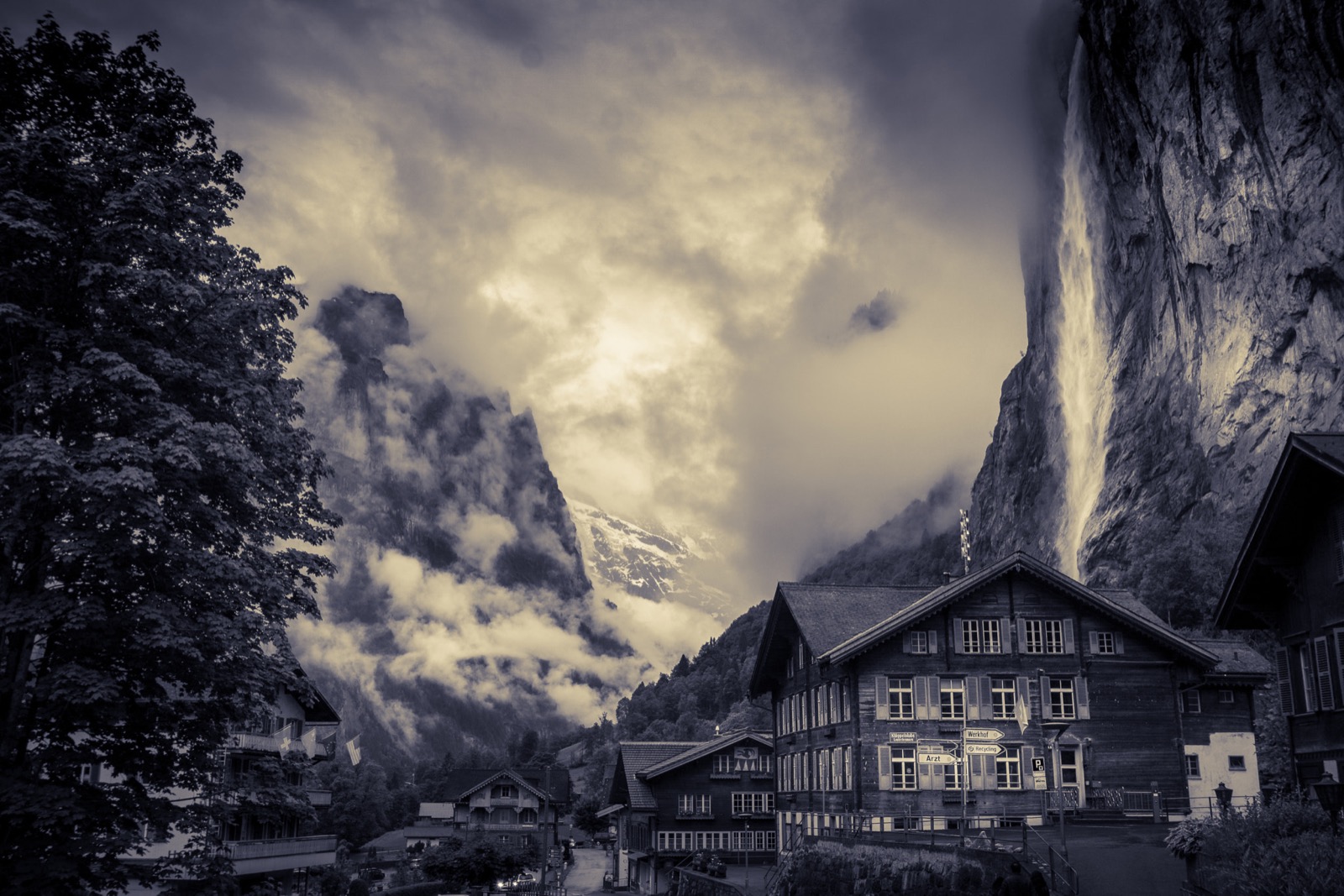
Photo: Mark Peters, CC0, via Wikimedia Commons
In this guide
Why go: a valley of 72 waterfalls
Lauterbrunnen is not a single sight you tick off; it is a landform. "Nestled between giant rock faces, the location is ideal for hiking and as a starting point for numerous day trips," the regional tourism site says — and then adds the line that sells the place: "If you are treating yourself to an overnight stay, you will awake to the sound of one of the 72 waterfalls."[4]
The valley is listed as part of the Swiss Alps Jungfrau-Aletsch UNESCO World Heritage Site, and the Trümmelbach itself is on the "Federal Inventory of Landscapes and Natural Monuments of National Importance".[2] A mostly flat walk runs from the village to Stechelberg "past streams cascading down vertical rock faces, some of which are several hundred metres high" — the easiest way to see how many waterfalls this valley really has.[2] There are also six UNESCO theme trails laid out in the valley for families.[4]
Practically: you can do Lauterbrunnen in a day from Montreux, but it is a full one — and the two waterfall visits below are what the day is for. If you would rather not build the rail legs yourself, the Interlaken side of the same region is covered in our Bernese Oberland day-trip guide.
The Trümmelbach Falls: ten waterfalls inside the mountain
This is the reason to come. The Trümmelbach does not fall off a cliff; it falls through one. Ten glacial waterfalls are cut into the rock inside the mountain, and a tunnel lift takes you up to galleries where you stand a few metres from water that has just come off the Eiger, Mönch and Jungfrau. The tourist office's own summary is hard to improve on: "Ten waterfalls inside the mountain, accessible with a tunnel lift - unique in Europe."[2]
The volume is the spectacle. The Trümmelbach "drains the huge glacier walls of the Eiger, Mönch and Jungfrau and transports up to 20000 litres per second" out of a catchment of 24 km², half of it covered in snow and ice.[2] In spring melt the galleries vibrate; by late summer it is a different, calmer place. The falls' own site repeats the point in its own words: the ten falls inside the mountain are "truly unique in Europe."[1]
Two things to plan around. First, it is seasonal: the falls are "generally open daily from the beginning of April until November from 9.00 until 17.00 - and in July and August from 8.30 until 18.00", and the operator warns to check exact dates at the start and end of the season.[1] The attraction is also "temporarily closed every spring due to extreme seasonal weather conditions" while the snowpack clears.[2] Second, it is not for everyone: for safety reasons children under 4 and dogs are not admitted.[2] Wear shoes with grip — the galleries are wet rock.
Staubbach Falls and the village floor
You will see the Staubbach before you have decided to visit it: it hangs above the village and is the image on every postcard of Lauterbrunnen. At "around 297 metres", it is billed by the local tourist office as "the highest free-falling waterfall in Switzerland" — the water leaves the rock face and simply falls, breaking into mist before it lands.[3]
That mist is the point: "Staub" means dust, and the spray that gives the falls their name is why Goethe was moved by the sight on his travels through the valley.[3] It is "at its most powerful in spring and early summer, when meltwater from the surrounding mountains feeds the cascade", and on warm summer evenings the setting sun turns the mist gold.[3] A properly built path leads to the foot of the falls; the rock gallery behind the water is open from May to October.[4]
Unlike the Trümmelbach there is no ticket, no lift and no queue: this one is free and belongs to the village. Budget an hour for the falls plus the walk back through Lauterbrunnen, which is small enough to cross on foot in ten minutes.
Tickets & opening hours
The Trümmelbach is the only paid element of the day, and the rates published by Lauterbrunnen's tourist office are simple:
| Visitor | Price |
|---|---|
| Adults | CHF 18.00 |
| Children and teenagers, 6 to 15 years | CHF 8.00 |
| Children under 4 years | not admitted (safety) |
| Dogs | not admitted (safety) |
Prices are quoted as "from" CHF 18.00 and CHF 8.00 respectively, so treat them as the entry band rather than a fixed rate.[2] Opening follows the season rather than the clock: from April to November daily 9.00–17.00, extended to 8.30–18.00 in July and August, with exact dates announced at the beginning and end of the season.[1] The Staubbach falls, the village and the valley walk cost nothing.
Getting there from Montreux by train
There is no secret fast route: Lauterbrunnen sits behind Interlaken, and you either come down the Rhône to Visp and back up through the Bernese Oberland, or take the scenic GoldenPass line direct to Interlaken West and change there. Both work as day trips; neither is quick. Two real results from Switzerland's open timetable data for a Saturday morning in October:
| Route | Example | Duration |
|---|---|---|
| Montreux → Visp → Thun → Interlaken Ost → Lauterbrunnen | dep 08:37 → arr 12:26 | 3 h 49, 3 changes |
| Montreux → Interlaken West (GoldenPass) → Wilderswil → Lauterbrunnen | dep 09:32 → arr 13:26 | 3 h 54, 2 changes |
Those are sample connections for one date, not a permanent timetable — and at the time of writing the Interlaken West–Wilderswil stretch was being served partly by a rail-replacement bus, so the second itinerary includes a short bus hop.[5] Check your own date before you book. The general routing is stable, though: "By rail: Via Bern or Lucerne to Interlaken-Ost. Change to the Berner Oberland-Bahn to Lauterbrunnen."[4]
In practice, that means an early start (the 08:37 is the sensible one), a village lunch around 13:00, the Trümmelbach in the afternoon, and a late return. If you would rather see the journey as the attraction, the GoldenPass Montreux–Interlaken line covers the first half of this trip on its own.
When to go
Follow the water. Spring and early summer are when "meltwater from the surrounding mountains feeds the cascade" and the Staubbach is "at its most powerful"; the same melt feeds the Trümmelbach's 20,000 litres a second.[2][3] That is also the window when the Staubbach rock gallery opens, from May to October.[4]
The trade-off is weather and closures. The Trümmelbach is "temporarily closed every spring due to extreme seasonal weather conditions", so the very earliest visits can miss it entirely — check before travelling, and remember the whole site shuts for the winter after November.[1][2] Late autumn is the quiet, stable choice: the valley empties after the summer crowds and the falls are still running. Mid-summer is the busiest and the driest, but it is also when you get the 8.30 opening and the longest day for the rail legs.
Up the valley: Wengen, Mürren and the Winteregg
If the falls take the morning rather than the day, the valley continues upward in two directions. On the Mürren side, "an aerial cableway travels from Lauterbrunnen to the Grütschalp summit station", where a narrow-gauge railway carries on to Winteregg and the car-free village of Mürren — marketed as the family excursion of the region, from CHF 11.[4] Above the other side of the valley, the cogwheel railway climbs towards Kleine Scheidegg and the Jungfraujoch, which is its own full day: see our Jungfraujoch guide.
Two smaller add-ons fit a Lauterbrunnen day better. The Blausee, a spring-fed lake in a forest clearing, is right on the road back towards the Rhône valley — our Blausee guide has the practicalities. And if you are travelling in the opposite direction, the same Bernese Oberland corridor leads up to Glacier 3000 above Les Diablerets, covered in our Glacier 3000 guide.
Start the day from Montreux
Lauterbrunnen is 3 h 45 by train from our apartments — which is why the 08:37 works. Kitchens for a 07:00 breakfast, parking if you drive part of it, and the lakefront ten minutes away when you get back at night.
See our apartmentsRelated reading: Jungfraujoch day trip · Bernese Oberland day trip · GoldenPass Express · Blausee

10+ years in hospitality. BBA Hospitality (Glion), MSc Tourism (FHGR), MSc Data Science (HSLU).
Frequently asked questions
How far is Lauterbrunnen from Montreux?
About 3 h 45 by train, with 2 to 3 changes: either down the Rhône to Visp and up through Thun to Interlaken Ost, or on the GoldenPass line direct to Interlaken West and then on to Lauterbrunnen. Sample October Saturday connections run Montreux dep 08:37 → Lauterbrunnen arr 12:26 (3 h 49, 3 changes) and Montreux dep 09:32 → Lauterbrunnen arr 13:26 (3 h 54, 2 changes).
What are the Trümmelbach Falls and are they worth it?
They are ten glacial waterfalls inside the mountain, reached by a tunnel lift — the only accessible glacial waterfalls located inside a mountain in Europe. The Trümmelbach drains the glacier walls of the Eiger, Mönch and Jungfrau and carries up to 20,000 litres of water per second out of a 24 km² catchment, half of it snow and ice. If you are going to Lauterbrunnen, this is the visit that justifies the journey.
How much does the Trümmelbach cost and when is it open?
Adults from CHF 18.00 and children and teenagers from 6 to 15 years from CHF 8.00. It is generally open daily from the beginning of April until November from 9.00 to 17.00, and in July and August from 8.30 to 18.00; exact dates are announced at the start and end of the season, and the site is also closed temporarily each spring while the snowpack clears. Children under 4 and dogs are not admitted, for safety reasons.
Which waterfall is the highest free-falling waterfall in Switzerland?
The Staubbach Falls above Lauterbrunnen village, with a drop of around 297 metres, is described by the local tourist office as the highest free-falling waterfall in Switzerland. The water leaves the rock face and falls freely, dispersing into mist — "Staub" means dust, and the spray gave the falls their name. It is free to visit, and the rock gallery behind the water is open from May to October.
When is the best time to visit the Lauterbrunnen valley?
Spring and early summer, when meltwater from the surrounding mountains makes the falls strongest. May to October is also the window when the Staubbach rock gallery is open. The compromise is that the Trümmelbach is temporarily closed every spring due to extreme seasonal weather conditions, and the whole site closes for the winter after November — so check the dates for your own trip.
Sources
- Trümmelbach Falls, official site (English) — ten glacial waterfalls "inside the mountain, made accessible by tunnel lift", "truly unique in Europe", generally open daily from the beginning of April until November from 9.00 until 17.00 and in July and August from 8.30 until 18.00 — truemmelbachfaelle.ch
- Lauterbrunnen Tourismus / Jungfrau Region (lauterbrunnen.swiss), "Trümmelbach Waterfalls" (English) — ten waterfalls inside the mountain with a tunnel lift, unique in Europe; drains the Eiger, Mönch and Jungfrau glacier walls with up to 20000 litres per second from a 24 km² catchment; part of the 72 waterfalls of the Lauterbrunnen valley; Federal Inventory of Landscapes and Natural Monuments and Swiss Alps Jungfrau-Aletsch UNESCO World Heritage; flat walk Lauterbrunnen–Stechelberg; closed temporarily every spring; children under 4 and dogs not admitted; adults from CHF 18.00, children and teenagers 6–15 from CHF 8.00 — lauterbrunnen.swiss — Trümmelbach Waterfalls
- Lauterbrunnen Tourismus / Jungfrau Region (lauterbrunnen.swiss), "Staubbach Waterfalls" (English) — "297 metres - The highest free-falling waterfall in Switzerland"; drop of around 297 metres; spray that gave the falls their name; Goethe inspired by the scenery; most powerful in spring and early summer; path to the foot of the falls — lauterbrunnen.swiss — Staubbach Waterfalls
- jungfrau.ch (Jungfrau Railways / Jungfrau Region Tourism), "Lauterbrunnen – Valley of 72 Waterfalls" — 72 waterfalls in the valley; Staubbach Falls with a 300 m drop and gallery from May to October; six UNESCO theme trails; "By rail: Via Bern or Lucerne to Interlaken-Ost. Change to the Berner Oberland-Bahn to Lauterbrunnen"; Lauterbrunnen–Grütschalp aerial cableway and the narrow-gauge railway on to Winteregg and Mürren, Winteregg–Mürren from CHF 11 — jungfrau.ch/en-gb/lauterbrunnen
- SBB / Swiss public transport open data (transport.opendata.ch) — sample Montreux → Lauterbrunnen connections for Saturday 24 October: dep 08:37 → arr 12:26 (3 h 49, 3 changes, via Visp, Thun and Interlaken Ost) and dep 09:32 → arr 13:26 (3 h 54, 2 changes, GoldenPass to Interlaken West, then rail-replacement bus and the Berner Oberland-Bahn) — transport.opendata.ch