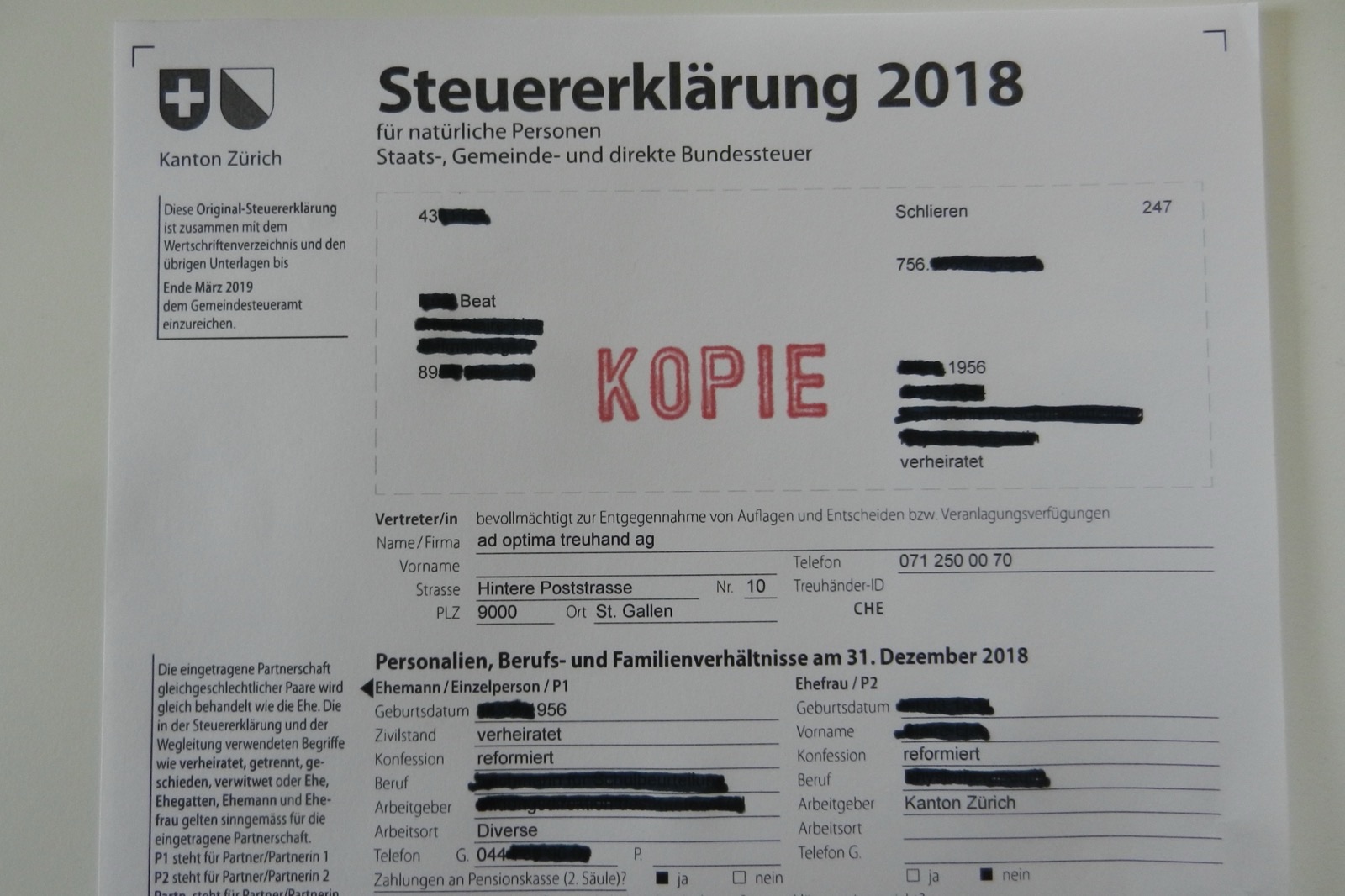
Photo: Beat Ruest, CC BY-SA 4.0, via Wikimedia Commons (cropped)

Every franc of rental income you declare is taxed — but not every franc you spent to earn it. Swiss tax law lets an owner deduct the cost of keeping a property in good repair, insuring it, and having it managed by a third party, before the rest is added to taxable income. The rules sound simple and the details are not: choosing the wrong method, or claiming a cost the tax office does not recognise as maintenance, either leaves money on the table or triggers a correction. Here is how the deduction actually works for a short-term rental, with the two traps that catch owners every year.
The short answer. You deduct, from gross rental income: mortgage interest, maintenance costs (either the actual, receipted amount or a flat-rate percentage — typically 10% of gross rent for buildings under 10 years old and 20% for older buildings[2]), insurance premiums, and the fee paid to a third-party manager.[1] You do not deduct the purchase of furniture, curtains or light fixtures as maintenance, and you do not deduct work that upgrades the property rather than preserves it — that only reduces capital gains tax on sale.[2]
The legal basis: Art. 32 DBG and the cantonal mirror laws
The federal direct-tax law is explicit about what a private landlord may deduct. For rented property in the private estate: “die Unterhaltskosten, die Kosten der Instandstellung von neu erworbenen Liegenschaften, die Versicherungsprämien und die Kosten der Verwaltung durch Dritte” — maintenance costs, the costs of restoring newly acquired property, insurance premiums, and the cost of management by a third party.[1] Every canton's tax law mirrors this list under the federal tax-harmonisation statute, so the categories are the same from Geneva to Zurich — only the flat-rate percentage and a handful of smaller items differ.
For a short-term rental owner, the practical reading is: your management company's commission is deductible on the same basis as a long-term-let landlord's Hauswart or agency fee. It is listed by name, not inferred.
Flat-rate deduction or actual costs: the annual choice
Swiss tax law gives every owner, for every property and every tax year, a choice between two methods for the maintenance line:
| Method | How it works | Best when |
|---|---|---|
| Pauschalabzug (flat-rate) | 10% of gross rent for buildings ≤10 years old on 1 January of the reference year; 20% for buildings over 10 years old[2] — claimed with no receipts | A quiet year with little actual spending |
| Effective costs | Every receipted, value-preserving expense added up and claimed in full | A year with a real repair, repaint or renovation bill |
Rates shown are the federal/most-common cantonal split by building age; Zurich and several other cantons apply a flat 20% to rented property regardless of age[2] — check your own canton's published rate before filing.
This is called the Wechselpauschale — the switching flat-rate — and the choice resets every year. The arithmetic is straightforward: if your actual, deductible maintenance spending in a given year is below the flat-rate percentage of gross rent, take the flat rate; if a real bill (a repainted facade, a replaced boiler) pushes actual costs higher, itemise instead. The two methods cannot be mixed within the same property in the same year.
What counts as maintenance — and what does not
The distinction tax authorities draw is between value-preserving work (werterhaltend) and value-adding work (wertvermehrend). Only the first is deductible against income tax:
- Deductible (value-preserving): repairs and like-for-like replacement of building components; a repainted wall; a repaired or replaced heating system; building insurance premiums (fire, water damage, glass, liability — not household contents); contributions to a condominium renovation fund (Erneuerungsfonds), provided the fund is used only for repair and upkeep; the cost of third-party property management.[1][2]
- Not deductible against income tax: work that permanently raises the property to a better standard than before (an added room, a first-time pool or sauna); the purchase or replacement of curtains, furniture, light fixtures, tools and appliances — explicitly excluded by name in cantonal practice[2]; your own labour; running-cost items tenants normally pay for directly.
What the official guidance actually says. Aargau's tax office lists, among costs that are not deductible: “Anschaffung und Ersatz von Vorhängen, Möbeln, Beleuchtungskörpern” — the purchase and replacement of curtains, furniture, and light fixtures.[2] That single line is the one most short-term rental owners trip over: the cost of furnishing the flat you let is not a maintenance expense, however necessary it is for the business. If you take the flat-rate deduction, furnishing wear is bundled into that percentage; if you itemise, furnishing simply is not on the list.
A single renovation invoice is frequently split between the two categories by the tax office — a kitchen replaced like-for-like is maintenance, a kitchen enlarged or upgraded in standard is partly value-adding. The Zurich cantonal tax office's own guidance frames it this way: “Umfasst eine Aufwendung sowohl einen werterhaltenden als auch einen wertvermehrenden Anteil, so wird der werterhaltende Anteil zum Abzug zugelassen, während der wertvermehrende Anteil nicht abzugsberechtigt ist” — where an expense is mixed, only the value-preserving share is deductible.[1]
Where the management commission fits
Because “Kosten der Verwaltung durch Dritte” — the cost of management by a third party — sits on the same deductible list as insurance and maintenance,[1] a flat commission paid to a property manager reduces taxable rental income the same way a repaired roof does. For an owner weighing self-management against a manager, the tax treatment is one more line in the comparison — alongside the hours self-managing actually costs, covered in our guide to the hidden costs of self-managing a Montreux rental.
What the deduction does not do is turn a loss-making year into a tax-free one on its own: it reduces the taxable base, it does not create a refund beyond what was otherwise owed. And it sits entirely inside income tax — it has no bearing on the separate VAT question. If your combined turnover across all short-term lets passes CHF 100,000, the VAT and tax guide for a Montreux rental covers that threshold and the reduced parahotellerie rate; the two taxes are assessed independently and the income-tax deductions above do not reduce VAT liability.
Declaring it: what to keep and where it goes
Whichever method you choose, the property and its gross rental income are declared in the real-estate section of the cantonal tax return, alongside the imputed rental value of any portion you occupy yourself. If you itemise actual costs, keep every invoice for the full retention period your canton requires — the tax office can request them during assessment, and an unsupported claim is simply disallowed rather than merely queried. A property held outside your canton of residence requires a separate return filed in that property's canton, regardless of whether you let it long-term or short-term.[1]
None of this is financial or tax advice for your specific situation — cantonal percentages and practice differ, and a tax adviser who knows your canton's Merkblatt should confirm the figures before you file. What a management company changes is simpler: it supplies the commission invoice that belongs on the deductible list, and — if you let through us — it runs the property at around 87% occupancy, roughly 34% above the same flats self-managed, for a flat 20% of the host payout (after platform fees, cleaning and city tax included), licensed apartments only, no setup fee, and a one-year contract, then 30 days’ notice.
Get a free, itemised revenue estimate
Send us the address and bedroom count. You get occupancy, nightly rate and projected annual revenue for the Montreux–Riviera market — flat 20% commission, no setup fee.
Get a free revenue estimateThe deduction choice is one line on a much longer form. For the rest of what a Montreux short-term rental costs to run before any deduction is applied, see our running-costs guide for 2027, and for the full set of revenue, pricing, compliance and tax material, start at the owner guides hub.

10+ years in hospitality. BBA Hospitality (Glion), MSc Tourism (FHGR), MSc Data Science (HSLU).
Frequently asked questions
Can I deduct the property management fee from my Swiss rental income?
Yes. Both federal law and cantonal tax law explicitly list the cost of third-party property management (Verwaltung durch Dritte) among the deductible items for rented real estate, alongside maintenance costs and insurance premiums.[1] A flat commission paid to a management company is this item.
What is the Pauschalabzug and how much is it?
It is a flat-rate deduction you can claim instead of itemising actual maintenance costs. The federal and most cantonal rates are 10% of gross rental income (or imputed value) for buildings up to 10 years old, and 20% for buildings over 10 years old.[2] Some cantons (e.g. Zurich) apply a flat 20% regardless of age for rented property. You choose, each year and each property, whichever method gives the bigger deduction — this is called the Wechselpauschale.
Can I deduct the cost of furnishing my short-term rental?
No, not as a maintenance deduction. Cantonal practice explicitly excludes the purchase or replacement of curtains, furniture and light fixtures (Anschaffung und Ersatz von Vorhängen, Möbeln, Beleuchtungskörpern) from the deductible-costs list.[2] Furnishing is an acquisition cost of your activity, not upkeep of the building, and is covered by the flat-rate deduction if you choose that method rather than claimed a second time as an expense.
What is the difference between value-preserving and value-adding work?
Value-preserving work (werterhaltende Aufwendungen) restores or maintains what already existed — a repainted wall, a repaired boiler, a like-for-like kitchen replacement — and is deductible. Value-adding work (wertvermehrende Aufwendungen) upgrades the property to a materially better standard and is not deductible against income tax; it is instead added to the acquisition cost and only reduces the eventual real-estate capital gains tax on sale.[1][2] A single renovation invoice is often split between the two.
Do these income-tax deductions have anything to do with VAT?
No — they are separate taxes with separate rules. The deductions on this page reduce your taxable rental income (federal, cantonal and communal income tax). Swiss VAT is a different, turnover-based tax that only applies above CHF 100,000 of combined turnover; see our dedicated guide to short-term rental tax and VAT in Montreux for that threshold and the parahotellerie rate.
Sources
- Kanton Zürich, kantonales Steueramt, Merkblatt über die steuerliche Abzugsfähigkeit von Kosten für den Unterhalt und die Verwaltung von Liegenschaften (ZStB Nr. 30.3), 26 March 2021, valid from tax period 2020 — quotes Art. 32 Abs. 2 DBG on deductible maintenance costs, insurance premiums and third-party management costs; distinction between value-preserving (werterhaltend) and value-adding (wertvermehrend) expenses. Consulted 7 November 2026.
- Kanton Aargau, 6.7 Liegenschaftsunterhalt, Wegleitung zur Steuererklärung — Pauschalabzug rates of 10% (buildings ≤10 years as of 1.1.2025) and 20% (>10 years) of gross rental income or imputed value; list of deductible and non-deductible expenditures, including the explicit exclusion of furniture, curtains and light fixtures. Consulted 7 November 2026.
General information on Swiss rental-income tax deductions, not tax advice for your specific situation — cantonal percentages and practice vary; confirm your canton's current Merkblatt and rates, or consult a tax adviser, before filing. Consulted 7 November 2026.
Base yourself in Montreux
RivieraHost’s apartments sit steps from the lake — with kitchens, more space and better value than a hotel for families and groups. Every one is right on this guide’s doorstep.