Most day trips from Montreux end at a lake or a cable-car station. The Verzasca Valley ends differently: at a granite gorge in Ticino where the river is so clear that the rocks under the surface look painted, and where the gateway to the valley is a 220-metre dam wall that James Bond jumped off in 1995. It is also the honest exception to this blog's day-trip habit — by public transport it is close to four hours each way, so it is a weekend, not a day out — and late autumn, with the chestnuts down and the summer crowds gone, is the best time to go.
The Verzasca Valley at a glance
- Where
- Ticino, 25 km north of Lake Maggiore, above Locarno[3]
- Main village
- Lavertezzo, home of the Ponte dei Salti[1]
- By train
- Montreux → Locarno 3h53 on the sample connection (dep 08:31, arr 12:24), then bus 321[6][8]
- By car
- 235.4 km / about 3h41 to the dam, free-flowing traffic[7]
- The dam
- Contra dam, 220 m — the GoldenEye jump was a drop of over 220 m[1][4]
- Bungee
- CHF 255 for adults (1–2 people); open Easter to October only[5]
- Season
- All year; spring and autumn for the bouldering[2][3]
A record, not a legend: James Bond's jump in the opening sequence of GoldenEye (1995), performed by Wayne Michaels, "was a drop of over 220 m (759 ft)" at the Verzasca hydro-electric dam — Guinness World Records still lists it as the "highest bungee jump from a structure in a film".[4]
Short answer: the Verzasca Valley (Valle Verzasca) is Ticino's granite gorge, 25 km north of Lake Maggiore above Locarno. You go for the emerald-green river and the polished rock pools at Lavertezzo, the Roman-style double-arch bridge Ponte dei Salti (the most photographed spot in the valley), the stone villages of Sonogno and Corippo, and the 220-metre Contra dam at the valley mouth. From Montreux it is 3h53 by train on the sample connection (Montreux dep 08:31 → Locarno arr 12:24) plus a bus up the valley, or 235.4 km and about 3h41 by car to the dam — so plan an overnight in Locarno or Ascona rather than a day trip.[1][2][3][6][7][8]
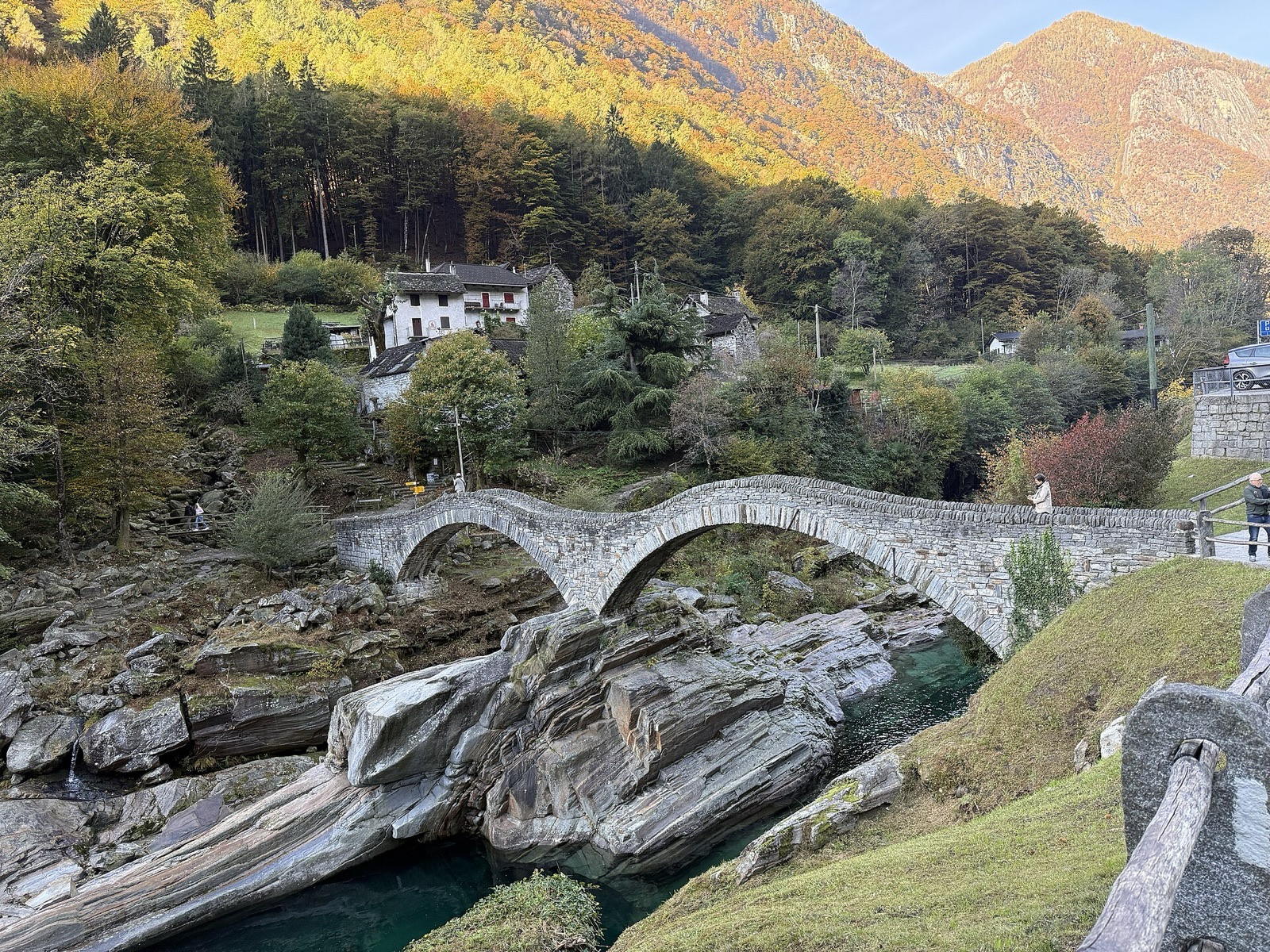
Photo: Astrometallico, CC0, via Wikimedia Commons
In this guide
Why go: Ticino's green heart
Ticino's tourist board is not exaggerating when it calls this valley "the green heart of Ticino": the Verzasca river runs emerald green through polished gorges and deep pools, and the valley itself stretches 25 kilometres north of Lake Maggiore, with Lavertezzo and Sonogno as its two best-known villages.[2][3] What makes it different from the rest of the Swiss Riviera is the geology. You leave the terraced vineyards of Lavaux, cross the Rhône valley, and drop into granite country where the water is a colour that no filter improves.
The first thing you meet is the entrance to the valley — and it is not subtle. As the local tourism board puts it, "nowhere else in the world is there a more spectacular valley entrance than that of this valley: it consists of the 220 metre high dam wall made famous by the jump in the James Bond film 'GoldenEye'".[2]
It is also a genuinely four-season destination: the valley is described as accessible all year, with activities that run from hiking and mountain biking to climbing, swimming and simply sitting still.[2][3] If you have already done our Rhine Falls day trip or the Lauterbrunnen waterfalls, this is the Ticino answer to both: water, stone and far fewer people.
What you actually see
The Ponte dei Salti at Lavertezzo. The valley's emblem is a double-arch stone bridge that "dates back to the 17th century and [was] restored in 1960 after a partial collapse in 1868", built across the Verzasca at one of its most beautiful spots.[1] It is the most photographed place in the valley — enough to have earned its own postage stamp — and the river basins between the smoothly polished granite rocks below it are the valley's most popular bathing spot and photo motif.[1][2][3]
One warning that matters more in autumn than in August: "the current of the Verzasca is unpredictable, pay attention to the signs", and the local tip is to come early in the morning, when there are fewer people.[3]
Sonogno, the last village. At the head of the valley, Sonogno is "the last village in the Valle Verzasca" — flower-decked stone houses, cobbled streets and a village square that still works as a meeting point.[1][2] Two small museums earn their stop: the Museo di Val Verzasca, which has occupied the 18th-century Casa Genardini since 1974, and the Casa della Lana, where wool is carded, dyed and spun by hand into blankets and scarves.[1][3] Just behind the village is the Cascate della Froda waterfall.[3]
Corippo, the smallest village. Corippo is "the second smallest village in Switzerland" — a tight cluster of single-room stone houses all facing the same way, clinging to the mountainside — and until 2020 it was the smallest municipality in the country.[1] It has since been converted into an "Albergo Diffuso", a dispersed hotel whose rooms, reception and restaurant are spread through the renovated village houses.[2] It also makes the classic mid-walk break on the Sentierone.[3]
The Sentierone and the family trails. The valley's signature hike is the Sentierone (SwitzerlandMobility 74), which runs the length of the valley from Sonogno to Locarno on the lake and can be walked in stages.[2] Switzerland Tourism gives it as a 24-kilometre trail from Sonogno via Lavertezzo to Locarno, through chestnut forests, past rustici, chapels and waterfalls, and suggests splitting it over two days.[3] With children, the valley's other institution is BoBosco, a set of natural wooden marble runs through the woods between Brione and Lavertezzo.[2]
If you climb rather than walk: Brione Verzasca has an extensive bouldering area that is especially popular in spring and autumn — which is exactly why this valley belongs on an autumn itinerary.[2]
The 007 dam and the GoldenEye jump
The wall that closes the valley at Vogorno is the Contra dam, 220 metres high, and its second career began with the opening sequence of GoldenEye. James Bond's jump there, performed by Wayne Michaels, was a drop of over 220 m — 759 ft — and Guinness World Records lists it as the highest bungee jump from a structure in a film.[4] The valley's own description is less corporate and more accurate: "a height of 220 m, an impressive drop and a seven and a half second free fall".[1] Since 2022 the dam has also hosted the Red Bull Dual Ascent, with teams of two climbing the wall.[2]
You can still jump it yourself. The operator on the dam runs the classic 007 jump head-first, arms wide, and publishes the prices:
| 007 Classic Jump | Price per person |
|---|---|
| Adults (from 20), 1–2 people | CHF 255.00 |
| Youths up to 19, full-time students or apprentices | CHF 195.00 |
| Repeaters, adults | CHF 195.00 |
| Second jump, same day and person | CHF 125.00 |
The season is the detail that decides your travel dates: the bungee site "is generally open from Easter weekend through to October", with jumps on Friday, Saturday and Sunday afternoons outside the summer peak — so a late-October trip is already past the end of it, and the jump resumes at Easter.[5] The meeting point is on the dam itself, roughly ten minutes before your slot, and the stop for it is literally called "Diga Verzasca", right next to the wall.[5][8]
Getting there from Montreux
By train, the route is the slow, scenic one — and it is worth it. A sample connection from SBB's timetable data runs Montreux dep 08:31 → Locarno arr 12:24, 3h53, changing at Domodossola onto the Centovalli railway (PE72) for the last leg into Locarno. A second option the same morning leaves Montreux at 09:10 and arrives at 13:24, 4h14, via Brig.[6] Check the current timetable before you book: that corridor has had rail-replacement work on some dates.
Then the bus. Trains stop first at Tenero and then at Locarno, "and from both places you'll be catching the yellow bus no. 321 in the direction of Sonogno — get off at 'Diga Verzasca'". The bus stop is right next to the dam, and Sonogno at the far end of the valley is reached by the same service from Locarno station.[3][8] Buses are the practical way to explore the valley, hikers included, and the PostBus service is covered by the Ticino Ticket if your accommodation issues one.[2]
By car, our routing gives 235.4 km and about 3h41 from Montreux to the dam, or 244.9 km and about 3h48 to Lavertezzo, in free-flowing traffic.[7] Take the Via Valle Verzasca turnoff at Gordola and follow the serpentine road: "until after about 2km a huge dam comes into sight", with a car park at the entrance to the dam.[8] Driving also lets you stop at each village on the way up, which the bus timetable does not.
Our honest reading: if you are coming by public transport, treat it as an overnight — four hours each way plus the valley bus is not a day trip. By car it is just about doable as a long day, but you will spend six hours driving and see half the valley.
When to go
The valley is open and described as visitor-accessible all year.[3] Autumn is the connoisseur's window for three reasons. The bouldering at Brione — one of the reasons climbers come to this valley at all — is "especially popular in spring and autumn".[2] The Sentierone's chestnut forests are at their best in the same weeks.[3] And the crowds that queue for the Ponte dei Salti in July have gone.
Two things do close down as the year turns. The bungee season ends in October.[5] And the bathing the valley is famous for belongs to summer — the deep pools below the bridge are "made for summer bathing", and with the current described as unpredictable, out of season the Verzasca is something to look at and listen to rather than swim in.[2][3]
Where to stay: Locarno, Ascona or the valley
The gateway towns are the practical base. Locarno and Ascona sit on Lago Maggiore about 20–25 minutes from the dam, and that is exactly where the bungee operator sends overnight guests looking for hotels, B&Bs and campsites.[5] Staying in Locarno also puts you on the bus corridor: the 321 up the valley leaves from the station, and the train back to Montreux starts from the same square.[8] If you would rather sleep inside the valley, Corippo's dispersed hotel is the unusual option — rooms, reception and restaurant spread through the renovated houses of the smallest municipality in Switzerland until 2020.[2]
A two-day shape that works: day one, arrive early and do the dam and Lavertezzo before the light goes; day two, take the bus to Sonogno and walk a stage of the Sentierone back down through Corippo, then spend the evening on the Locarno lakefront. If you want more Ticino in the same trip, our Blausee guide covers the opposite kind of water — the alpine lake on the Bernese side — while this valley is the warmer, wilder one.
Base yourself in Montreux
Ticino is a weekend; the Riviera is your base for everything else. Kitchens for early starts, parking nearby and the lakefront ten minutes away when you get back.
See our apartmentsRelated reading: Rhine Falls day trip from Montreux · Lauterbrunnen & the Trümmelbach Falls · Creux du Van, the Jura amphitheatre

10+ years in hospitality. BBA Hospitality (Glion), MSc Tourism (FHGR), MSc Data Science (HSLU).
Frequently asked questions
Is the Verzasca Valley a day trip from Montreux?
Only by car, and even then it is a long one: our routing gives 235.4 km and about 3h41 to the dam, and 244.9 km / 3h48 to Lavertezzo, before you drive a single valley road. By train, a sample connection runs Montreux dep 08:31 to Locarno arr 12:24 — 3h53 — and you still need bus 321 up the valley. Four hours each way plus the local bus is a weekend, not a day out.
How much does the GoldenEye bungee jump cost?
The classic 007 jump on the Contra dam is CHF 255 per person for adults (one or two people), CHF 195 for youths up to 19 and for full-time students or apprentices, and CHF 195 for adult repeaters; a second jump the same day costs CHF 125. Training, the jump, a soft drink, the certificate and the dam jump fee are included.[5]
When is the bungee jump on the Verzasca dam open?
The site is generally open from Easter weekend through to October. In April and October it operates on Friday, Saturday and Sunday afternoons; from June to mid-September it opens Wednesday to Sunday afternoons. Late autumn and winter are closed, so time a jump trip between Easter and October.[5]
Can you swim in the Verzasca river?
The rock pools below the Ponte dei Salti at Lavertezzo are the valley's most popular bathing spot, and the Verzasca's deep pools and polished gorges are made for summer bathing. The current, however, is described as unpredictable — pay attention to the signs, and come early in the morning to have the bridge to yourself. Outside the summer months the water is a thing to look at rather than swim in.[2][3]
How do you reach the Verzasca Valley without a car?
Take the train to Tenero or Locarno, then the yellow bus no. 321 in the direction of Sonogno and get off at the "Diga Verzasca" stop — the bus stop is right next to the dam. The same bus line continues to Sonogno at the head of the valley, and the PostBus service through the valley is included in the Ticino Ticket.[2][8]
Sources
- Fondazione Verzasca, official "Discover the Valle Verzasca" page (English) — Ponte dei Salti (17th century, restored 1960 after the 1868 partial collapse, most photographed place in the valley with its own postage stamp), Museo di Val Verzasca in the 18th-century Casa Genardini since 1974, Casa della Lana, Sonogno as the last village, Corippo as the second smallest village in Switzerland, and the Contra dam / GoldenEye jump at 220 m with a seven-and-a-half-second free fall — verzasca.ch/en/discover-the-valle-verzasca
- Organizzazione turistica Lago Maggiore e Valli (Ascona-Locarno), official "Valle Verzasca" page (English) — the "green heart of Ticino", the 220 m dam wall made famous by GoldenEye, the Red Bull Dual Ascent since 2022, the Ponte dei Salti as the valley's most photographed object, bouldering at Brione popular in spring and autumn, the Sentierone (SwitzerlandMobility 74) from Sonogno to Locarno, BoBosco, Corippo as the smallest municipality in Switzerland until 2020 and its "Albergo Diffuso", and the PostBus service included in the Ticino Ticket — ascona-locarno.com/en/explore/valle-verzasca
- Switzerland Tourism (myswitzerland.com), "Verzasca valley" — valley stretching 25 km north of Lake Maggiore, the Roman double-arch Ponte dei Salti, the 220-metre dam, the 24-kilometre Sentierone from Sonogno via Lavertezzo to Locarno in two stages, bus access from Locarno station, the unpredictable current, and the valley being listed as accessible all year — myswitzerland.com/en-ch/experiences/verzasca-valley-cool-green-water
- Guinness World Records, "Highest bungee jump from a structure in a film" — GoldenEye (1995), performed by Wayne Michaels, a drop of over 220 m (759 ft) at the Verzasca hydro-electric dam, Switzerland — guinnessworldrecords.com
- 007 Bungy Verzasca, official "Classic bungee jump 007" page — prices (CHF 255 adults 1–2 people, CHF 195 youths/students, CHF 195 repeaters, CHF 125 second jump), what is included, meeting point on the dam, and the season from Easter weekend through October — 007bungy.ch/en/bungy_jumps/1-007-bungy-jump
- SBB / Swiss public transport open data (transport.opendata.ch) — sample connections Montreux → Locarno, read 23 October 2026: dep 08:31 arr 12:24 (3h53, via Domodossola and the Centovalli railway); dep 09:10 arr 13:24 (4h14, via Brig) — transport.opendata.ch
- OpenStreetMap road data routed with the OSRM engine (project-osrm.org) — free-flow driving distances and times read 23 October 2026: Montreux → Diga Verzasca (Vogorno) 235.4 km / 3h41, Montreux → Lavertezzo 244.9 km / 3h48. Free-flow times exclude traffic, stops and season — project-osrm.org
- 007 Bungy Verzasca, official travel and location information — bus no. 321 from Tenero or Locarno in the direction of Sonogno, get off at "Diga Verzasca" (stop beside the dam); by car take the Via Valle Verzasca turnoff at Gordola and follow the serpentine road until the dam appears after about 2 km — 007bungy.ch/en