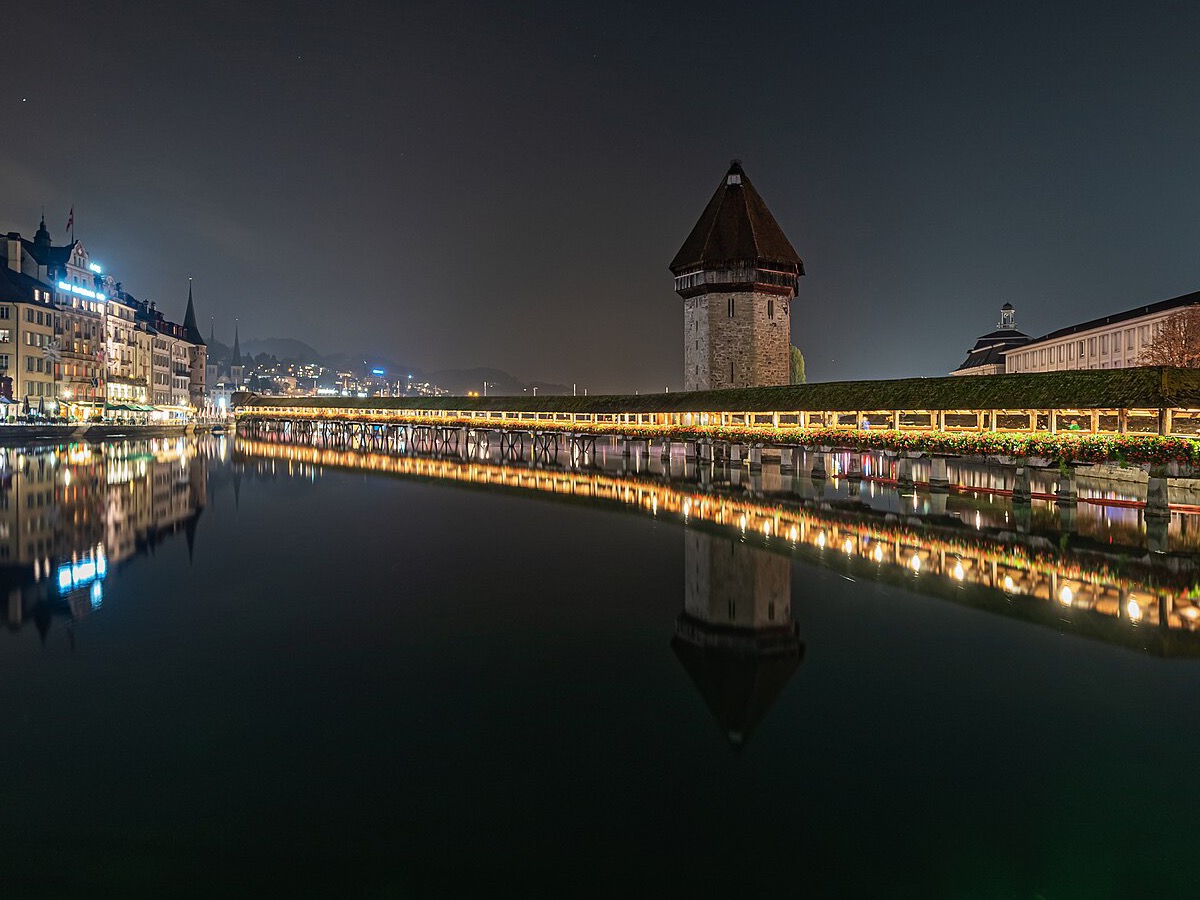
Photo: JoachimKohler-HB, CC BY-SA 4.0, via Wikimedia Commons
.jpg)
Lucerne is the Swiss city where the rulebook, not the market, sets the business model. Since 1 January 2025 a dwelling in a residential zone can be let short-term for 90 nights a calendar year, the unit needs a registration number displayed in the listing, and going beyond the cap requires the city's confirmation. That changes the arithmetic of an apartment here: when the number of sellable nights is capped, everything depends on what you charge for them — and on what the rest of the year does.
This guide sets out what a Lucerne apartment actually earned in the twelve months to July 2026, where the spread between two similar flats comes from, and how the 90-night regime, the registration duty and the tourist taxes fit together. Every market figure comes from AirROI's Lucerne dataset for August 2025 to July 2026, converted to Swiss francs at CHF 0.81 per US dollar, the rate we use across our Swiss market guides.
What a Lucerne short-term rental earns in 2026
The average active listing earned USD 45,954 (about CHF 37,223) across the year, at an average nightly rate of USD 323 (CHF 262) and 48.0% occupancy — USD 164 (CHF 133) of revenue per available night. Supply is small and concentrated: 354 active listings, around three quarters of them entire homes or apartments, with total market revenue up 5.0% year on year.
The distribution is the more useful half of the picture:
| Lucerne listings, twelve months to July 2026 | Revenue as reported |
|---|---|
| Average listing in the market | CHF 37,223 a year · CHF 262 nightly rate |
| Median listing | CHF 3,413 a month |
| Top quarter of listings | around CHF 6,056 a month |
| Top tenth of listings | around CHF 9,357 a month |
The occupancy tiers explain most of that spread before pricing even enters the picture: the top quarter of Lucerne listings run at 76% occupancy or better, the median sits near 54%, and the bottom quarter averages 27%. The average booking in this market is made 68 days ahead of arrival, and guests stay 4.1 nights on average.
Why two similar flats earn different money
Key figure. The average Lucerne short-term rental earned USD 45,954 (about CHF 37,223) in the twelve months to July 2026, at a nightly rate of USD 323 (CHF 262) and 48.0% occupancy, while the top tenth of listings cleared around USD 11,552 a month (CHF 9,357). Source: AirROI Lucerne market dataset, retrieved 18 September 2026.
A CHF 37,223 average year at a CHF 262 nightly rate is the equivalent of about 142 nights — more than the 90-night budget the regulation allows in a residential zone. That single comparison shows how the top of this market is built: exempt units, the above-cap confirmation, or bookings of three months and longer, which do not count against the 90 nights. Four levers separate the median from the top:
- Rate, because the nights are rationed. The strongest month of the year priced at USD 396 (CHF 321) a night while the slowest month fell back to USD 241 — with a limited number of sellable nights, a rate set once and never revisited is the most expensive habit in the market.
- Product mix. 30.5% of Lucerne listings (108 of them) require a 30-night minimum stay, and those long bookings are exactly the ones that do not consume the 90-night budget. The extended-stay lane is already a third of this market.
- Calendar discipline. 37.9% of listings accept one-night bookings, and with 68 days of average lead time the calendar has to be open and priced long before guests start looking at it.
- Turnover economics. Shorter stays mean more changeovers, laundry and check-ins per franc of revenue; the listings that treat cleaning and check-in as part of the rate model, rather than an afterthought, are the ones holding their margin.
Seasonality: an August peak, a February trough
Lucerne is a genuinely seasonal market. The strongest month in the dataset booked USD 7,953 (about CHF 6,442) at 65.0% occupancy and a USD 396 (CHF 321) nightly rate. The weakest booked USD 2,929 (CHF 2,372) at 38.2% occupancy. Between the best and the worst month, revenue swings by roughly 2.7× in the same apartment. Peak season is May, June and August; the soft stretch runs from January to March.
- Price the peak, don't average it. Two or three months at peak-season rates carry a disproportionate share of the year, and in a 90-night market they are the nights that decide the annual result.
- Give winter a different product. January to March is where mid-term stays fill the calendar — the market's longest average stays (4.7 nights) fall in February.
- Watch the booking window. Lead time runs to about 88 days for summer stays and as low as 47 days for March arrivals; a calendar that is priced late loses the deepest part of the demand.
The rules: a 90-night cap, a registration number and the Kurtaxe
The framework comes from the popular initiative "Wohnraum schützen – Airbnb regulieren", approved by Lucerne voters in March 2023 with more than 64% support. The city's Reglement über die Kurzzeitvermietung was adopted on 13 June 2024 and has applied since 1 January 2025. It has four moving parts:
- A 90-night cap. Short-term letting of accommodation in residential zones is limited to 90 nights per calendar year for stays under three months. Bookings of three months or more do not count against the limit.
- A registration number in the listing. Non-exempt units must be notified to the City of Lucerne and receive a registration number that has to be displayed in the platform listing. Each apartment needs its own.
- A confirmation above the cap. Letting for more than 90 nights a year requires the city's confirmation as well. It is granted if you can show that the unit has not been used as living space since 2010, or that no living space was removed or destroyed to create the space on offer since 2010 — a deliberately narrow door.
- Exemptions. Tourism and agricultural zones sit outside the regime, and so does home-sharing in your own main residence, provided you do not draw an abusive profit from it.
Then there is the tax. Guests pay the city's Kurtaxe of CHF 2.30 per person per night on apartments, guest rooms, holiday homes and similar accommodation under the city's Kurtaxenreglement, and since 1 January 2026 the cantonal Beherbergungsabgabe adds CHF 1.10 per guest per night, doubled from 50 centimes. The annual lump sum of CHF 360 that owners of holiday flats used to be able to pay is no longer allowed where the flat is let commercially — and the city sets that threshold at more than 90 days a year, the same line as the letting cap.
In practice, clarify a unit's status before you buy or convert anything: the 2010 test is a property question, not a pricing one, and it is the one test that can rule an apartment out of short-term letting entirely.
What you keep: fees, cleaning and tax
Gross bookings are not income. On a median month of CHF 3,413, Airbnb's host service fee — 15.5% under simplified pricing — takes roughly CHF 529, leaving about CHF 2,884 before cleaning, laundry, utilities and your mortgage. The cleaning fee normally passes through to the guest rather than coming out of your rate, which is why under-setting it caps what you can ask for a single night. The Kurtaxe and the cantonal Beherbergungsabgabe are charged on top, per guest, and never belong in the income you quote.
Beyond that, short-let income is taxable in Switzerland and VAT can enter the picture once turnover passes the registration threshold; we cover that arithmetic in our guide to Airbnb tax and VAT.
Self-manage, or hand it over
Self-managing in Lucerne is realistic if you live in the city, keep the calendar open and revisit rates monthly. The cost of doing it badly is higher here than elsewhere, because a 90-night market forgives nothing: an unfilled August peak, or a minimum-stay setting that blocks the mid-term demand the cap leaves free, is revenue you cannot recover later in the year.
Across our own managed portfolio, professionally operated apartments average around 87% occupancy and roughly 34% more revenue than self-managed flats in the same markets. We work on a flat 20% commission on net booked revenue, licensed apartments only, with 30 days notice on either side — no lock-in, no fee on nights we don't sell.
What could your Lucerne apartment earn?
Send us the address and the layout. We will project a realistic annual figure at Lucerne rates, with the 90-night position, the tourist taxes and the compliance lines shown separately.
Get a free revenue estimate
10+ years in hospitality. BBA Hospitality (Glion), MSc Tourism (FHGR), MSc Data Science (HSLU).
Frequently asked questions
How much can a short-term rental in Lucerne earn?
The average active listing in the Lucerne market earned about USD 45,954 (CHF 37,223) in the twelve months to July 2026, at a USD 323 (CHF 262) nightly rate and 48.0% occupancy. The median listing turned over around CHF 3,413 a month and the top tenth of listings around CHF 9,357 a month.
Is there a 90-night rule in Lucerne?
Yes. Under the city's Reglement über die Kurzzeitvermietung, in force since 1 January 2025, short-term letting of a dwelling in a residential zone is limited to 90 nights per calendar year for stays under three months. Bookings of three months or more do not count against the cap, tourism and agricultural zones are excluded, and so is home-sharing in your own main residence.
Do I have to register an apartment in Lucerne before listing it?
Yes, unless the unit is exempt. Non-exempt accommodation units must be notified to the City of Lucerne and receive a registration number that has to be displayed in the listing. Letting for more than 90 nights a year additionally requires a confirmation from the city, which it grants if the unit has not been used as living space since 2010 or if no living space was removed or destroyed to create the space on offer.
What tourist taxes do guests pay in Lucerne?
Guests pay the city Kurtaxe of CHF 2.30 per person per night for apartments, guest rooms and holiday homes under the city's Kurtaxenreglement, plus the cantonal Beherbergungsabgabe, which rose to CHF 1.10 per person per night on 1 January 2026. The annual lump sum of CHF 360 is no longer available where the flat is let commercially, and the city treats letting for more than 90 days a year as commercial.
What does a manager charge for a Lucerne apartment?
RivieraHost charges a flat 20% commission on net booked revenue, with 30 days notice on either side and licensed apartments only. Across our own managed portfolio, professionally operated flats average around 87% occupancy and roughly 34% more revenue than self-managed apartments.
Comparing Swiss markets? Our Bern owner guide runs the same numbers for the capital, where planning law rather than a night cap is the binding constraint, and the owner guides hub collects every market we cover.
Sources: AirROI Lucerne market dataset, August 2025 to July 2026 (retrieved 18 September 2026); Stadt Luzern, Reglement über die Kurzzeitvermietung (sRSL 7.9.1.1.1, in force 1 January 2025); Stadt Luzern, Kurtaxenreglement (sRSL 9.2.4.1.1); Kanton Luzern, revised Tourismusgesetz (cantonal Beherbergungsabgabe CHF 1.10 from 1 January 2026); City of Lucerne, stay limit and registration guidance; Airbnb Help Center on hosting in the City of Lucerne.
Base yourself in Montreux
RivieraHost’s apartments sit steps from the lake — with kitchens, more space and better value than a hotel for families and groups. Every one is right on this guide’s doorstep.