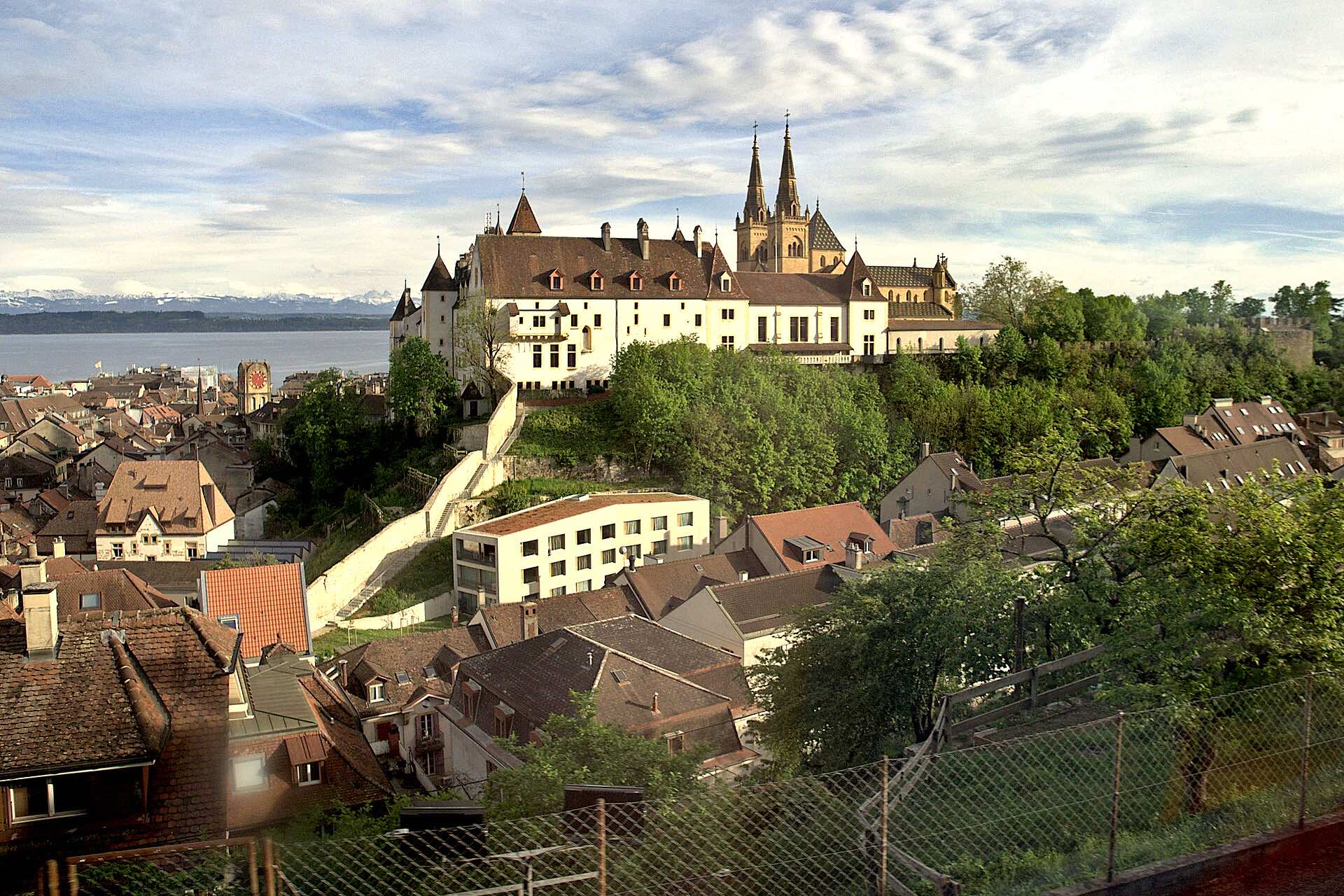
Photo: Château de Neuchâtel and the Collégiale by BootRoot, Wikimedia Commons, CC BY 4.0 (cropped)

Neuchâtel does not behave like a big-city rental market, and that is exactly why it is worth understanding. There are 138 active short-term listings in the market and 71% of them are entire homes, a stock that skews to one-bedroom flats (47.1%) rather than the large family apartments that dominate the Vaud Riviera. What the market lacks in scale it makes up for in regularity: a university city, a cluster of watchmaking and precision-industry employers, cantonal administration, and a lakefront that fills every May.
This guide sets out what a Neuchâtel apartment actually earned in the twelve months to July 2026, where the gap between the average listing and the top end comes from, what the cantonal tourist tax does to the guest's bill, and what all of it means if you own a flat here and are deciding how to let it.
What a Neuchâtel short-term rental earns in 2026
Neuchâtel at a glance: 138 active listings, a USD 165 average daily rate (about CHF 134), 36.8% occupancy and USD 14,478 of average annual revenue — roughly CHF 11'727 a year, or CHF 977 a month for the average active listing. 27.5% of the market already runs stays of 30 nights or more.
The average active listing turned over USD 14,478 (CHF 11,727) in the year to July 2026 at a USD 165 (CHF 134) average daily rate and 36.8% occupancy. Revenue per available night — the number that decides whether a flat is worth operating at all — sat at USD 64 (CHF 52).
| Neuchâtel market, Aug 2025 – Jul 2026 | Value |
|---|---|
| Active listings | 138 |
| Average annual revenue | USD 14,478 ≈ CHF 11'727 |
| Average daily rate | USD 165 ≈ CHF 134 |
| Revenue per available night | USD 64 ≈ CHF 52 |
| Occupancy (listing average) | 36.8% |
| Entire-home listings | 71% |
| One-bedroom listings | 47.1% |
| Stays of 30 nights or more | 27.5% of listings |
| Average booking lead time | 46 days |
| Average guest rating | 4.76 / 5 |
Occupancy: the gap that decides the year
36.8% is an average, and averages hide the only number that matters to an owner: how far your flat sits from the top of the market. Neuchâtel's best-performing listings run above 81% occupancy, while the bottom quartile sits near 17%. Between those two flats sits the whole difference between an asset that pays for itself and one that quietly loses money.
Part of that gap is structural, part operational. Structurally, an entire home in the old town or along the lake lets better than a room in a shared flat, and a one-bedroom near the university serves a different calendar — semester arrivals, visiting researchers — than a two-bedroom near the water, which lives on weekends and holidays. Operationally, lead time is the tell: the average booking in Neuchâtel is made 46 days out, with May taking the largest share of the year's nights. A calendar that is still empty for the last weekend of April is a calendar that will show up in the statistics as an average listing.
The arithmetic of closing the gap is simple. At the market's CHF 134 average daily rate, ten extra occupancy points are 36.5 additional nights, or about CHF 4'891 a year in gross revenue — before any commission, and before the extra cleaning cycles those nights bring with them.
Who books Neuchâtel, and what they rate
Two things stand out in the booking data. First, this is not a weekend-tourism market: 27.5% of listings take stays of 30 nights or more, against only 5.1% concentrated in the 7-to-29-night band. The long-stay segment — university visitors, project engineers, guests between two leases — is already a quarter of the market, and it is usually the most profitable slice per hour worked, because one contract replaces four or five check-ins.
Second, guests are satisfied and specific. The average rating is 4.76 out of 5 across roughly 45 reviews per listing, and 36.2% of listings carry a Guest Favorite badge. Where the market does differentiate, it is on ordinary things: AirROI's revenue-impact ranking for Neuchâtel puts a hair dryer at the top, and listings that have one average USD 17,444 a year against USD 5,404 for those that do not. That is a correlation rather than a magic wand — the same listings tend to be the ones with a complete photo set, fast replies and a properly blocked calendar — but it points the right way: the return comes from finishing the basics, not from a designer sofa.
The cantonal tourist tax and the transport card
Neuchâtel levies a cantonal tourist tax on overnight stays, and the mechanism is worth knowing before you set your rates. Guests who pay it receive the Neuchâtel transport card, which covers the local public transport network for the duration of their stay — a genuine selling point you can put in the listing, and one that costs you nothing. In a city where guests arrive by train and the lakefront, the old town and the university are all within walking or tram distance, it removes the last excuse for arriving by car.
Two practical points. The tax is charged per person per night on top of your nightly rate, so present it to guests as a separate, regulated charge rather than folding it into the price you advertise. And because Airbnb does not handle automatic tourist-tax collection in the same way in every Swiss canton, confirm with your commune how the tax is collected for your property; where it is not collected on your behalf, you register, declare and remit it yourself. Our guide to Airbnb tax and VAT in Switzerland walks through the mechanics, including the 15.5% host fee and what is and is not deductible.
What this means if you own a flat in Neuchâtel
Three decisions drive most of the outcome:
- Position for the long stay as well as the short one. With 27.5% of the market on 30+ nights, a monthly rate 30–40% below the weekly equivalent can be the most profitable line in your calendar, because it removes turnover cost and seasonality at the same time.
- Price to the 46-day lead time, not to today. Neuchâtel demand arrives roughly six weeks before the stay, so last-minute discounting mostly gives away margin on nights that would have sold anyway. Review the calendar weekly and trim rates only inside the final ten days.
- Know the building before the listing goes live. A condominium (PPE) regulation that bans short lets, or a commune that requires authorisation, ends the project faster than any occupancy problem. Our owner guides hub covers registration, night caps in other cantons and the insurance questions, and the same checklist applies here.
Costs come off the top line too: a management commission, cleaning between every stay and the tourist tax all sit between the guest's payment and your bank account. That is why the number to steer by is net revenue per available night, not the nightly rate shown on your listing.
Managing it yourself, or handing over the keys
Self-management works when you live in the building or fifteen minutes away, answer messages within the hour, and treat the calendar as a weekly task rather than a seasonal one. It fails in a specific way: the first year goes well on novelty, the second year reviews slip because a check-in was missed in a busy week, and the listing quietly settles at the market average.
Across our own managed portfolio, professionally operated apartments average around 87% occupancy and roughly 34% more revenue than the same flats managed by their owners. The difference is not marketing spend; it is calendar discipline, weekly rate management, and reviews answered before they turn into ratings.
RivieraHost charges a flat 20% commission on net booked revenue, works with licensed apartments only, and either side can end the mandate on 30 days' notice.
What could your Neuchâtel apartment earn?
Send us the address and the layout. We will project a realistic annual figure at Neuchâtel rates, flag the tourist-tax and condominium questions for your commune, and show what the fees leave behind.
Get a free revenue estimate
10+ years in hospitality. BBA Hospitality (Glion), MSc Tourism (FHGR), MSc Data Science (HSLU).
Frequently asked questions
How much can a short-term rental in Neuchâtel earn in 2026?
The average active listing in the Neuchâtel market earned about USD 14,478 (CHF 11,727) in the twelve months to July 2026, at a USD 165 (CHF 134) nightly rate and 36.8% occupancy. That works out at roughly CHF 977 a month, with the best listings well above that figure and the weakest quartile far below.
What occupancy rate should I expect in Neuchâtel?
The listing average is 36.8%, but the spread is what matters: the top listings run above 81% occupancy while the bottom quartile sits near 17%. The average booking is made 46 days ahead and May carries the largest share of the year, so calendar discipline and early-season pricing explain most of the difference.
What tourist tax applies to a short-term rental in Neuchâtel?
Neuchâtel levies a cantonal tourist tax on overnight stays. Guests who pay it receive the Neuchâtel transport card, which covers the local public transport network for their stay. The tax is charged per person per night on top of the nightly rate, and because Airbnb does not handle automatic collection the same way in every Swiss canton, owners should confirm with their commune whether it is collected on their behalf or must be declared and remitted directly.
Is the monthly-stay segment worth targeting in Neuchâtel?
Yes. 27.5% of listings in the market take stays of 30 nights or more, against only 5.1% concentrated in the 7-to-29-night band. University visitors, project engineers and guests between two leases make up a quarter of the market, and one long booking replaces several check-ins, cleaning cycles and laundry runs.
Does RivieraHost manage apartments in Neuchâtel?
RivieraHost is based in Montreux and works with owners across Switzerland. We charge a flat 20% commission on net booked revenue, work with licensed apartments only, and either side can end the mandate on 30 days' notice. Across our managed portfolio, professionally operated apartments average around 87% occupancy and roughly 34% more revenue than the same flats managed by their owners.
Comparing markets? Our Lausanne owner guide runs the same numbers for the Vaud capital next door, the Lucerne guide explains what a 90-night cap does to a year, and the channel mix guide shows how much of a Swiss year should come from direct bookings.
Sources: AirROI Neuchâtel market dataset, August 2025 to July 2026 (retrieved 20 September 2026), USD figures converted at 0.81 USD/CHF; Airbnb help centre, tourist tax and the Neuchâtel transport card for the canton of Neuchâtel (accessed 20 September 2026). Market figures describe the dataset and are not a guarantee of individual results.
Base yourself in Montreux
RivieraHost’s apartments sit steps from the lake — with kitchens, more space and better value than a hotel for families and groups. Every one is right on this guide’s doorstep.