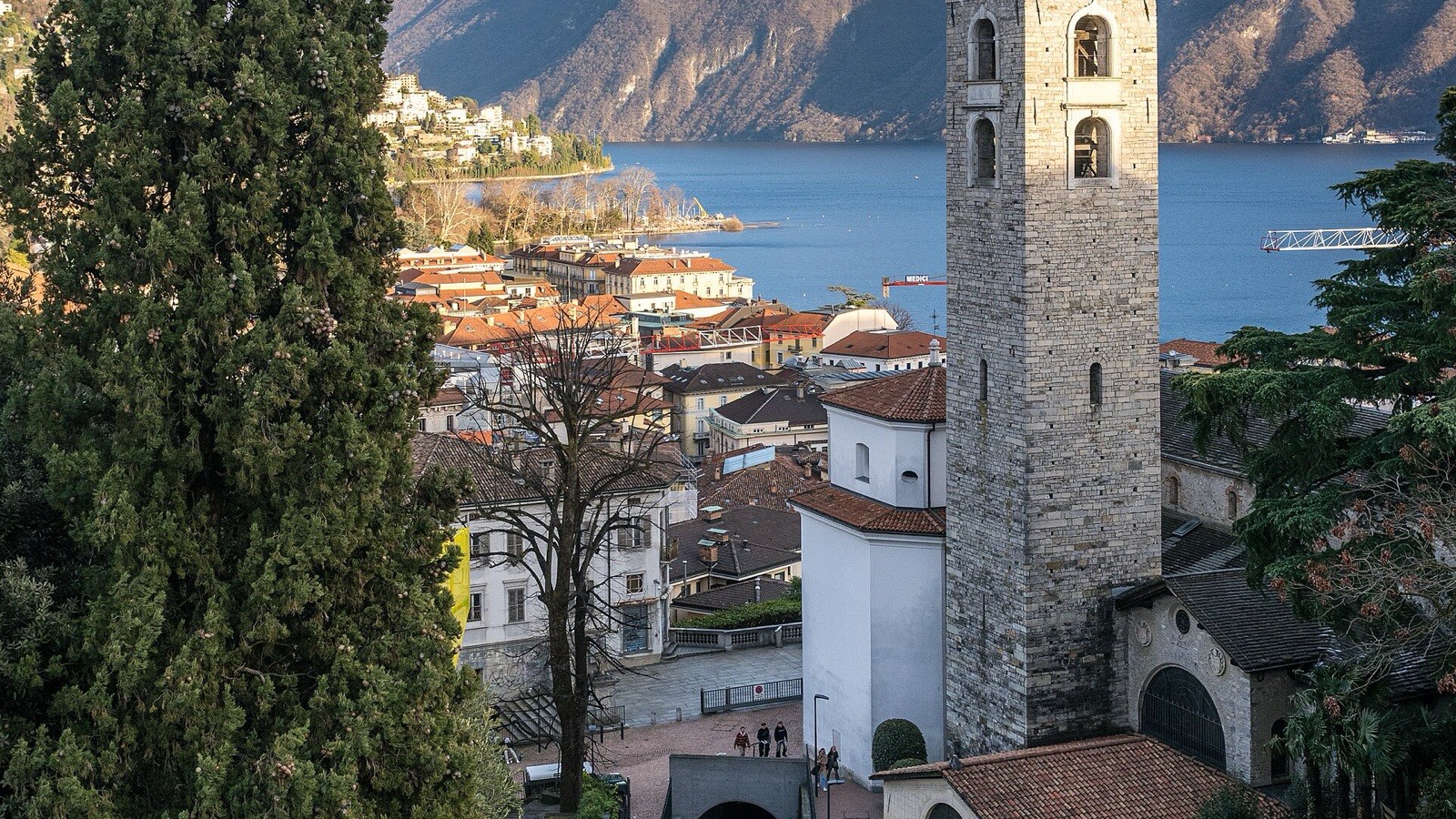
Photo: Blick vom Bahnhof auf Lugano by JoachimKohler-HB, Wikimedia Commons, CC BY-SA 4.0
.jpg)
Lugano is the Swiss short-term rental market that behaves least like Switzerland. Listings are written in Italian, the season runs from spring to the end of October, and a large share of guests arrives from Milan, Zurich and the United States rather than from the domestic weekend trade. It is also the market where the rulebook weighs most, because Ticino regulates nightly letting more strictly than any other canton.
This guide sets out what a Lugano apartment actually earned in the twelve months to July 2026, where the gap between the average listing and the top end comes from, how the 90-day rule and the tourist tax work in practice, and what all of it means if you own a flat between Paradiso and Canobbio.
What a Lugano short-term rental earns in 2026
Lugano at a glance: 593 active listings, a USD 236 average daily rate (about CHF 191), 35.7% occupancy and USD 21,315 of average annual revenue — roughly CHF 17'265 a year, or CHF 1'439 a month, with the top quarter of listings above CHF 2'903 a month.
The average active listing turned over USD 21,315 (CHF 17'265) in the year to July 2026 at a USD 236 (CHF 191) average daily rate and 35.7% occupancy. Revenue per available night — the figure that actually compares one listing with another — was USD 83, about CHF 67. Market-wide revenue slipped 1.5% year on year, so this is not a market that lifts every apartment: it is a market where the top quartile earns roughly twice the average.
| Lugano market, Aug 2025 – Jul 2026 | Value |
|---|---|
| Active listings | 593 |
| Average annual revenue | USD 21,315 ≈ CHF 17'265 |
| Average daily rate | USD 236 ≈ CHF 191 |
| Revenue per available night | USD 83 ≈ CHF 67 |
| Occupancy (listing average) | 35.7% |
| Typical booking lead time | 48 days |
| Stays of 30 nights or more | 40.5% of listings |
| Stays of 7 to 29 nights | 1.9% of listings |
| Listings charging a cleaning fee | 87.5% (average USD 150 ≈ CHF 122) |
| Revenue change, year on year | −1.5% |
| Listings showing a registration number | 83% |
Cleaning is the line item that surprises owners most: the average Lugano listing charges USD 150 (CHF 122) per stay, or 12.8% of gross revenue — more than a management commission at our own rates. Every extra turnover in a month eats into that margin, which is why the 1.9% of listings positioned between 7 and 29 nights are the least common configuration in the market.
Occupancy, seasonality and the booking window
Occupancy averages 35.7%, and the distribution behind that figure is the useful part. A third of the market (33.1%) is booked for 91 to 180 nights a year, 14% sells more than 181 nights, and more than half of all listings still show 271 to 366 nights available across the year. The average apartment in Lugano therefore leaves most of its calendar unsold — and that unsold inventory, not the nightly rate, is where revenue is decided.
Two disciplines close most of the gap. The first is pricing to the booking window: with a 48-day lead time, demand arrives roughly seven weeks before the stay, so rates should be set and reviewed for that horizon rather than discounted at the last minute. The second is seasonal: revenue in Lugano peaks in July, with a long shoulder from April to October, while November to February is a genuinely local, low-rate period that only works with long stays.
Who books Lugano, and why it changes the calendar
Swiss guests account for 31.2% of the market and American guests for 19.1%, with English the working language of 37.5% of listings — an unusually international mix for a city of this size. That matters twice over: cross-border guests from Milan and Zurich book short city breaks at a weekend premium, while the academic and financial-sector demand around USI books long stays midweek.
The result is a structurally split market. 40.5% of listings (240 apartments) run a 30-night minimum stay, close to half the market, and only 1.9% sit in the 7-to-29-night band between a weekend break and a monthly let. Owners who serve both profiles — flexible short stays in the high season, a monthly let through the winter trough — collect twice from the same apartment.
The 90-day rule: what Ticino actually asks of you
Ticino regulates nightly letting through building law rather than a licence register. Under article 3 of the cantonal building-law regulation, letting an apartment to tourists for up to 90 days per calendar year is not considered a change of use: it requires an announcement to the commune, not a permit. Let for more than 90 days in a year and the operation becomes an application for change of use — a building-law procedure a commune can refuse, and one that some communes tie to the number of units you let.
Above six beds and 90 nights a year, a structure is treated as hospitality accommodation and falls under the cantonal hospitality-law regime, with duties that look far more like running a small hotel than renting out a flat. The practical consequence is that the answer to "can I let this apartment?" is neither national nor cantonal: it belongs to the commune where the building stands. Our guide to registration in Valais and Vaud shows how differently two neighbouring cantons handle the same question.
The market data reflects that pressure: 83% of active listing records in Lugano already carry a registration reference, a far higher share than in most Swiss cities. Buy the apartment, then get the commune's position before you buy the furniture.
What guests pay on top: CHF 3.25 a night
Since 1 January 2025 the Ticino tourist tax on an apartment is CHF 2.00 per person per night, to which the cantonal promotion tax of CHF 1.25 is added — CHF 3.25 per person per night in total. Structured apartment complexes rated as the equivalent of a zero- to three-star hotel pay CHF 4.20, and that higher band includes the Ticino Ticket, which gives guests free public transport across the canton for the whole stay. A plain private holiday flat normally does not issue the Ticino Ticket, which is worth knowing before you compare yourself with a serviced residence a few streets away.
Private hosts report their stays to the regional tourism organisation at least once a year, by 5 January for the previous year; professional structures report monthly, by the 5th of the following month. The tax is collected from the guest and passed on, so it is not your revenue — but a listing that quotes CHF 191 without explaining that CHF 3.25 per person per night is added loses bookings at the payment page.
What this means if you own a flat in Lugano
Three decisions drive most of the outcome:
- Settle the commune question first. Announcement or change of use, the number of units you let and the condominium rules all come before pricing. Put the questions to your commune in writing and keep the answer.
- Design the calendar around two guest profiles. With 40.5% of the market on 30-night minimums, a monthly rate 30–40% below the weekly equivalent in the winter trough is usually worth more than chasing low-occupancy weekends in January.
- Price to the 48-day lead window and protect July. The peak revenue month should be sold at full rate in May and June; last-minute discounts belong in November and February, not in the high season.
Costs sit between the guest's payment and your account: the platform fee, the management commission, cleaning at roughly CHF 122 a turnover, and the tourist tax you collect but do not keep. Net revenue per available night is the only figure worth comparing across apartments.
Managing it yourself, or handing over the keys
Self-management works in Lugano if you live in the city, speak Italian with the commune and the neighbours, and can absorb a turnover in the middle of a weekend. It fails in a predictable way: the first winter, when the short-stay calendar empties, the long-stay segment was never set up, and the apartment sits near 15% occupancy until spring.
Across our own managed portfolio, professionally operated apartments average around 87% occupancy and roughly 34% more revenue than the same flats managed by their owners. The difference is rarely the nightly rate; it is calendar design, the long-stay pricing ladder, and answering enquiries in the guest's language within the hour.
RivieraHost charges a flat 20% commission on net booked revenue, works with licensed apartments only, and either side can end the mandate on 30 days' notice.
What could your Lugano apartment earn?
Send us the address and the layout. We will project a realistic annual figure at Lugano rates, flag the tourist-tax and change-of-use questions for your commune, and show what the fees leave behind.
Get a free revenue estimate
10+ years in hospitality. BBA Hospitality (Glion), MSc Tourism (FHGR), MSc Data Science (HSLU).
Frequently asked questions
How much can a short-term rental in Lugano earn in 2026?
The average active listing in the Lugano market earned about USD 21,315 (CHF 17'265) in the twelve months to July 2026, at a USD 236 (CHF 191) nightly rate and 35.7% occupancy. That works out at roughly CHF 1'439 a month, with the top quartile of listings above USD 3,584 and the weakest performers well below the average.
What occupancy rate should I expect in Lugano?
The listing average is 35.7%, and the market is uneven: a third of listings are booked for 91 to 180 nights a year, 14% sell more than 181 nights, and more than half still show 271 to 366 nights available for the year. The typical booking is made 48 days ahead and July is the strongest revenue month, so early pricing discipline explains most of the difference between two identical flats.
Does the 90-day rule apply in Ticino?
In substance, yes. Under article 3 of the Ticino building-law regulation, letting an apartment to tourists for up to 90 days per calendar year is not a change of use and only requires an announcement to the commune; beyond 90 days a change-of-use application is needed, and a structure with more than six beds let more than 90 nights a year falls under hospitality-law duties. Communes can add conditions of their own.
What tourist tax do guests pay in Lugano?
Since 1 January 2025 the Ticino lodging tax is CHF 2.00 per person per night for apartments and holiday homes, plus a CHF 1.25 promotion tax, so CHF 3.25 in total. Structured apartments equivalent to a zero- to three-star hotel pay CHF 4.20 and include the Ticino Ticket for free canton-wide public transport. Private hosts report stays to the regional tourism organisation at least once a year, by 5 January.
Does RivieraHost manage apartments in Lugano?
RivieraHost is based in Montreux and works with owners across Switzerland, Ticino included. We charge a flat 20% commission on net booked revenue, work with licensed apartments only, and either side can end the mandate on 30 days' notice. Across our managed portfolio, professionally operated apartments average around 87% occupancy and roughly 34% more revenue than the same flats managed by their owners.
Comparing markets? Our Lucerne guide shows what a 90-night cap does to a city market, and the Lausanne guide runs the same numbers for the Vaud capital.
Sources: AirROI Lugano market dataset, August 2025 to July 2026 (retrieved 21 September 2026), USD figures converted at 0.81 USD/CHF; Regolamento di applicazione della legge edilizia (RLE), art. 3 cpv. 1 lett. p, and the Canton Ticino tourism-law tax table published on ticino.ch (accessed 21 September 2026). Market figures describe the dataset average and are not a guarantee for an individual apartment. Photo: JoachimKohler-HB, CC BY-SA 4.0, via Wikimedia Commons.
Base yourself in Montreux
RivieraHost’s apartments sit steps from the lake — with kitchens, more space and better value than a hotel for families and groups. Every one is right on this guide’s doorstep.